TOFU, MOFU, BOFU: What They Mean and Examples for Each Funnel Stage
10 min read · AstraLoop Studio
TOFU, MOFU, BOFU: what they actually mean
These are three acronyms that show up in every marketing course, usually explained with a little funnel diagram and not much else. The problem is that without concrete examples, they stay abstract labels. And abstract labels don't help you sell.
Let's get to the substance. TOFU, MOFU, and BOFU describe the three stages a stranger goes through on the way to becoming a customer, moving from the top of the funnel to the bottom:
- TOFU (Top of Funnel), the top. Here you find people who don't know you yet and may not even realize they have the problem you solve. Goal: get found and grab attention.
- MOFU (Middle of Funnel), the middle. Here you find people who've realized they have a problem and are weighing how to solve it. Goal: educate, build trust, qualify.
- BOFU (Bottom of Funnel), the bottom. Here you find people who are ready to decide and are choosing between you and the alternatives. Goal: clear away the last doubts and close the deal.
The logic is simple: each stage matches a different level of awareness, so it needs different content and a different goal. Someone finding you for the first time isn't ready to receive a quote, and someone who's already asked for a quote doesn't need an introductory article. Getting the content wrong for the stage is the mistake that wastes budget and makes it look like "marketing doesn't work."
In this article we'll walk through the three stages one by one, with real-world examples for B2B and services, the typical mistakes made at each one, and how to connect them to your customer acquisition system so contacts don't get lost moving from one stage to the next.
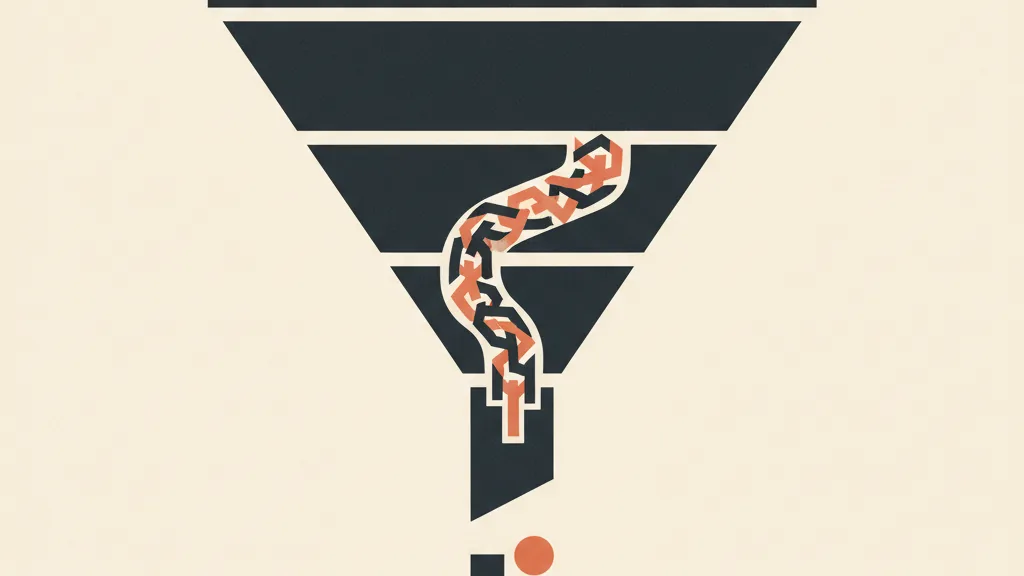
TOFU: the top of the funnel (awareness)
TOFU is where the widest, coldest audience enters. People with a latent need, a question, an itch, who haven't yet pinned down the problem and definitely aren't searching for you specifically. You're not selling anything here: you're getting found and showing you understand their world.
What TOFU is for
Attracting qualified traffic and turning strangers into an audience that knows you. You're not asking for data or booking appointments yet: you're building awareness and initial trust. The metric that matters here isn't revenue, it's attention volume (visits, reach, subscribers) and the quality of that audience.
Examples of TOFU content
- Blog posts that answer informational questions ("what does... mean", "how does... work", "why does... happen").
- Social posts and short videos that tap into a problem common to your ideal customer.
- Introductory guides, infographics, downloadable checklists without too many barriers.
- Awareness campaigns on Meta or Google that catch informational searches.
Concrete example. Say you're an accountant looking for clients among young sole proprietors. A TOFU piece of content isn't "trust us", it's an article like "Flat-rate tax scheme: who qualifies and who doesn't." Whoever reads it isn't a client yet, but they're exactly the audience that will be looking for an accountant six months from now. This is, in effect, lead generation at its earliest stage: creating demand before you even capture it.
Typical TOFU mistake
Selling too soon. Putting a heavy contact form or a salesy tone on content meant for people who don't know you yet scares the audience off. TOFU exists to fill the top of the funnel: if you push too hard too early, you end up with nothing flowing downstream. The opposite mistake is just as costly: attracting generic, off-target traffic that inflates visits without feeding the funnel.
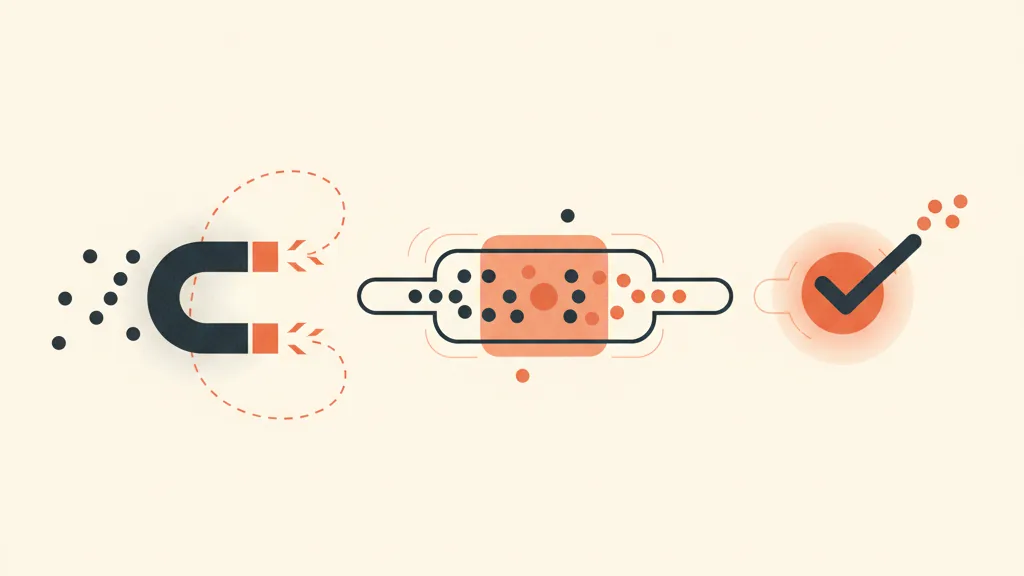
MOFU: the middle of the funnel (evaluation)
MOFU is the most neglected stage and, not by coincidence, the one where the most contacts get lost. Here you find people who've realized they have a problem and are weighing their options, but aren't ready to buy yet. Most of your prospects live in this zone longer than you'd think. Ignoring it means losing the largest slice of the market.
What MOFU is for
Turning an interested audience into qualified contacts. Two things happen here: you capture the contact's data (a lead becomes yours, not just an anonymous visitor) and you start educating them and building authority. At the same time, you qualify the leads: figuring out who's genuinely in-target and who isn't, so sales reps don't waste their time. This is the stage where a raw lead becomes a qualified lead (MQL or SQL).
Examples of MOFU content
- High-value lead magnets (ebooks, templates, calculators, webinars) in exchange for contact details.
- Nurturing email sequences that educate over time and keep the relationship alive.
- Case studies and comparison articles ("X vs. Y", "how to choose...").
- Content that explains your method and differentiates your approach.
Concrete example. A solar panel installer offers a savings calculator: the user enters their consumption and location, gets an estimate, and leaves their details. From that point on they enter a sequence explaining incentives, payback times, differences between systems. It's not a quote yet: it's nurturing. Whoever makes it to the end of that sequence is far warmer than someone who just clicked an ad.
Typical MOFU mistake
Silence. This is where the biggest, most invisible damage happens: you capture the contact and then do nothing, or send a single email and stop. The lead who isn't ready today (the majority of them) gets abandoned, and six months later they'll buy from the competitor who kept showing up. MOFU runs on systematic follow-up: without a sequence that keeps delivering value, you're throwing away most of what you paid for in advertising. It's one of the main reasons a funnel doesn't convert even though it's bringing in contacts.
Got content that attracts people but contacts get lost moving from one stage to the next? Request a free analysis: we'll map out your TOFU, MOFU, and BOFU together and tell you exactly where your funnel is losing customers today.
BOFU: the bottom of the funnel (decision)
BOFU is the decision stage. Here the contact knows you, trusts you enough to seriously consider you, and is choosing between you and a few alternatives. It's the stage closest to revenue and, usually, the best covered, but it still has its traps.
What BOFU is for
Clearing away the last obstacles and driving the conversion: a signed quote, a booked appointment, a completed purchase. You no longer need to educate on the problem (that's already clear), you need to give the final proof and make it easy to say yes.
Examples of BOFU content
- Demos, free trials, free analyses or audits of the specific case.
- Custom quotes and consultation calls.
- Testimonials, reviews, guarantees, and proof of results ("here's what we achieved for companies like yours").
- Clear offer pages, with terms, timelines, and the next step spelled out.
Concrete example. Someone who's reached BOFU doesn't want another article: they want to see you in action on their case. A free audit, a simulation on their actual scenario, a call where you show them exactly what you'd do. BOFU content is specific, not generic: it speaks to their situation, not the problem in the abstract.
Typical BOFU mistake
A slow handoff. The lead fills out the quote request or books a call while at peak attention. Call them back two days later and that attention has already faded, and they may have already talked to a competitor. The second classic mistake is handing a contact to sales without context: whoever doesn't have the lead's history in front of them (where they came from, what they've read, what they've asked) starts from zero and wastes the work done in earlier stages.
The three stages compared
If there's one thing to remember, it's this: each stage has its own level of awareness, its own goal, and its own type of content. Lining them up side by side helps you see where your funnel is strong today and where it's exposed.
| Stage | Who's there | Goal | Typical content | Key metric |
|---|---|---|---|---|
| TOFU (top) | Doesn't know you, latent problem | Attract and get found | Blog, video, guides, awareness ads | Qualified traffic |
| MOFU (middle) | Knows they have a problem, evaluating | Educate, capture data, qualify | Lead magnets, nurturing, case studies | Qualified leads |
| BOFU (bottom) | Ready to decide, choosing | Convince and close | Demos, quotes, audits, testimonials | Close rate |
No single stage is enough on its own. TOFU alone: plenty of audience, zero conversions. BOFU alone: you close well, but on too small an audience because nothing is filling the top. MOFU alone: you nurture contacts that never get around to deciding. The strength lies in the full journey, where each stage feeds the next. This is exactly the logic behind the stages of the sales funnel, seen from the content side.
Where the theory breaks down: the handoff between stages
Here's the part few articles cover. In practice, the problem is almost never understanding what TOFU or BOFU are. The problem is the handoff between one stage and the next. That's where leads evaporate.
A contact enters TOFU through an article, downloads a lead magnet in MOFU, then... what happens? If that contact ends up in a spreadsheet nobody looks at, or gets a single email and then silence, the funnel breaks. The three stages can be flawless on paper and still lose customers in the middle, because between one stage and the next there's no system keeping them connected.
That system is the CRM. The funnel is the journey (the three stages), the CRM is the memory and the engine that moves each contact from one stage to the next without forgetting anyone. If you want the precise distinction between the two, we've explained it in the difference between a funnel and a CRM. In practice you need both: the funnel defines TOFU/MOFU/BOFU, the CRM keeps them alive.
Concretely, a well-connected funnel does this:
- Captures the lead the moment they make contact and logs it immediately in the CRM, with the source and the stage they're in.
- Assigns priority (whoever's hottest goes to the top) via lead scoring, so sales reps work the right contacts first.
- Automatically triggers the nurturing sequence suited to the stage, without anyone having to remember to do it manually.
- Hands the ready lead (BOFU) to sales with the full history, exactly when it's the right moment.
Without this infrastructure, TOFU/MOFU/BOFU stay three boxes on a slide. With it, they become an engine that runs. If you want to see the full operational flow, from first click to signature, we've detailed it in the funnel that feeds the CRM, and in the customer acquisition funnel you'll find the complete picture.
Where to start
You don't need to build all three stages at once. The practical way to start is to map what you already have: what TOFU content you're producing, whether there's a MOFU mechanism to capture and nurture contacts, and how fast and clean your BOFU is. A clear gap almost always shows up, and that's the bottleneck to close first.
A sensible order for most small businesses and professional firms:
- Fix BOFU if you're losing already-warm contacts (slow replies, quotes that fall through the cracks). It's the fastest return.
- Build MOFU if you're capturing contacts but not nurturing them: this is where most companies leave money on the table.
- Fuel TOFU once the two downstream stages are working, to increase the volume entering the journey.
If you want to understand the underlying logic before picking channels, read the difference between inbound and outbound in B2B: it changes how you fill TOFU, but the three stages stay the same. And when you're ready to put it all into practice, the guide on how to build a customer acquisition funnel gives you the operational steps.
Frequently asked questions
What do TOFU, MOFU, and BOFU mean?
They're the three stages of the funnel, viewed from top to bottom. TOFU (Top of Funnel) is the top, where you attract people who don't know you yet. MOFU (Middle of Funnel) is the middle, where you educate and qualify people who've realized they have a problem. BOFU (Bottom of Funnel) is the bottom, where you close people who are ready to decide. Each stage matches a different level of awareness, so it needs different content and a different goal.
What's the difference between TOFU, MOFU, and BOFU?
The difference lies in the contact's level of awareness. In TOFU, the person doesn't yet know they have a problem, so they want informational content (blog posts, videos, guides). In MOFU, they're weighing solutions, so they want lead magnets, nurturing, and case studies. In BOFU, they're ready to buy, so they want demos, quotes, and proof of results. Getting the content wrong for the stage is the mistake that wastes budget.
What are concrete examples of content for each stage?
TOFU: an article like 'Flat-rate tax scheme: who qualifies', a video tapping into a common problem. MOFU: a savings calculator in exchange for contact details, a nurturing email sequence, a case study. BOFU: a free audit on the specific case, a custom quote, testimonials and guarantees. The rule is: the further down you go, the more specific and sales-oriented the content becomes.
At which funnel stage do most customers get lost?
MOFU, the middle. It's the most neglected stage: many companies capture the contact and then never nurture it, or send a single email and stop. The lead who isn't ready today (the majority) gets abandoned and six months later buys from the competitor who kept showing up. Without a consistent nurturing sequence, you throw away most of what you paid for in advertising.
How do TOFU, MOFU, and BOFU connect to each other?
The connection is the handoff, and that's usually where the funnel breaks. Keeping the three stages linked requires a CRM: it logs the contact the moment TOFU happens, assigns it a priority, automatically triggers MOFU nurturing, and hands sales the ready BOFU lead with full history. Without this system, the three stages stay disconnected boxes on a slide and contacts evaporate in between.
Do I need to build all three stages together?
No, and it's often counterproductive. It's better to map what you already have and close the biggest gap first. A sensible order for most small businesses: fix BOFU if you're losing already-warm contacts (fastest return), then build MOFU if you're capturing contacts without nurturing them, and finally fuel TOFU to increase incoming volume once the downstream stages are working.
Want to turn the three stages into a system that runs on its own, with a CRM keeping every contact on track? Talk to us: we design the funnel and CRM tailored to your process, from the top all the way to close.