Acquisition Funnel: What It Is and the Stages of a Multi-Step Funnel
8 min read · AstraLoop Studio
If you've ever sat through a call with an agency talking about a "funnel" and come away feeling like they were selling you smoke, this article is for you. An acquisition funnel isn't a marketing trick. It's simply a way of describing the journey a person takes from "never heard of you" to "bought from you." Nothing magical about it, just an orderly way of looking at how customers actually arrive.
The problem is the word gets thrown around loosely. Some people call a single landing page a "funnel," others confuse it with an email sequence, others use it as a synonym for "sales funnel" without ever explaining what happens inside it. Here we'll set the record straight: what it is, what "multi-step" means, what the real stages are, and how to tell if yours is working or leaking from every seam.
Acquisition funnel: what it is, in plain terms
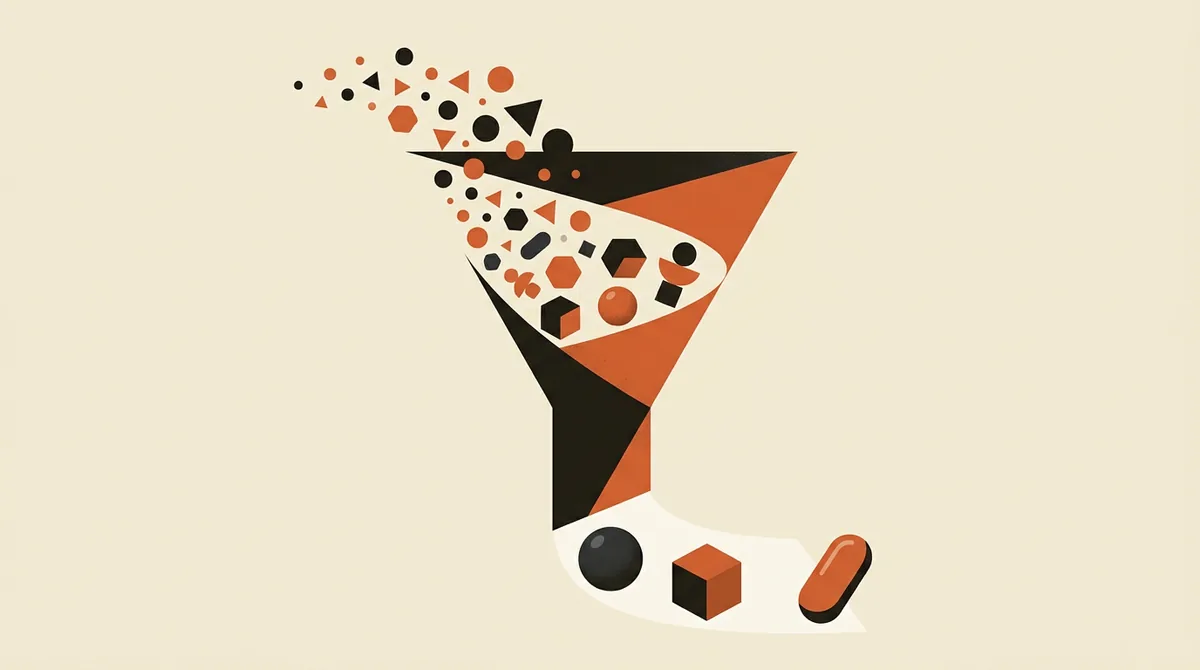
An acquisition funnel is a map of the stages a potential customer passes through before buying. It's called a funnel for a precise geometric reason: a lot of people go in at the top, fewer and fewer make it through each stage down, and at the bottom, out comes whoever becomes a customer. The funnel shape describes exactly that natural filtering.
Here's a concrete example. Imagine you sell a consulting service for €3,000:
- 1,000 people see one of your posts or ads
- 150 click through to your site
- 40 leave their details (a lead: name, email, maybe a phone number)
- 15 reply to your messages or book a call
- 4 become paying customers
That's your funnel. Each line is a stage, and every step from one line to the next has its own conversion rate. Going from 1,000 down to 4 customers means you lost 99.6% of people along the way, and that's completely normal. The goal isn't to eliminate the drop-off (impossible), it's to understand where it's concentrated and reduce it wherever that's cheapest to do.
The difference between a business that grows and one that limps along often has nothing to do with the product, and everything to do with whether these numbers are being tracked. A business without a defined funnel is flying blind: "this year went well, not sure exactly why." A business that has one knows that a 20% bump in top-of-funnel traffic translates into roughly 20% more customers at the bottom. That's the foundation for making customer flow predictable instead of random.
What "multi-step funnel" actually means (no jargon)
"Multi-step" simply means "in several stages." It's the opposite of a single-step funnel, the kind where you expect a total stranger to buy on first contact.
A single-step funnel sounds like this: an ad, then "buy now for €3,000." It only works for cheap, impulse-buy products, or for people who already know you. If you sell B2B services, consulting, or high-ticket products, this approach burns through budget. You're asking for too much, too soon, from people who have no reason to trust you yet.
A multi-step funnel breaks that ask into digestible stages. Instead of asking for the wallet right away, you first ask for attention, then a small yes, then a bigger yes. Each step lowers the barrier for the next one. A typical example looks like this:
- Step 1, attention: a useful piece of content, an ad, a post that speaks to a problem the prospect actually feels.
- Step 2, micro-commitment: download a guide, watch a video, join a list. It costs the prospect little, but gives you a contact.
- Step 3, relationship: a few emails or messages that demonstrate expertise, without selling anything yet.
- Step 4, conversation: a call, a demo, a quote. Here you're talking to someone who's already warmed up.
- Step 5, sale: the final offer reaches someone who knows you, trusts you, and has an active problem.
The advantage of multi-step is essentially mathematical: you recover people who weren't ready on first contact. In B2B, most potential customers don't buy "today," but might buy in two or three months. A single-step funnel loses them for good. A multi-step funnel keeps them warm until they're ready.
The stages of the acquisition funnel
Beyond the number of technical steps, every funnel moves through four psychological stages. It's worth knowing them, because they tell you what needs to happen in the customer's head, not just which page they need to see.
1. Awareness (TOFU, top of funnel)
The person discovers that a solution to their problem exists. They're not evaluating you yet, they're just noticing you exist. This is where content, ads, SEO, LinkedIn posts, and word of mouth live. The classic mistake is trying to sell already at this stage: it's like proposing marriage on a first date.
2. Consideration (MOFU, middle of funnel)
Now they're evaluating you, probably alongside two or three other providers. They compare, they read, they ask around. This stage calls for content that demonstrates competence: case studies, technical explanations, answers to objections. It's also the moment you turn an anonymous visitor into an identified contact. If you want to go deeper on getting more real contacts through the door, read our guide on how to generate qualified leads.
3. Decision (BOFU, bottom of funnel)
They're ready to choose, but they want final reassurance: price, guarantees, timelines, social proof. This is where quotes, demos, sales calls, and testimonials come in. It's the stage where the sale is won or lost, and paradoxically it's the one most companies invest the least attention in.
4. Post-acquisition (retention)
The funnel doesn't end at the signature. A satisfied customer buys again, brings referrals, and lowers your average acquisition cost. Ignoring this stage means having to refill the top of the funnel from scratch every single time, which is the most expensive way to grow a business.
Acquisition funnel and lead quality: not all contacts are worth the same
A common mistake is measuring the funnel purely on volume: "we collected 200 leads this month." But if only 10 of those 200 actually had budget and intent to buy, you've just filled the funnel with noise. Your sales rep's (or setter's) time gets burned chasing people who will never buy.
That's why the funnel needs a quality filter built in. There's a distinction between a marketing-qualified lead and a sales-qualified lead (MQL and SQL): the first has shown interest, the second also has budget, authority, and urgency. A healthy funnel doesn't push everyone toward the sale, it selects. If you want the practical criteria for filtering contacts, we've dedicated a full piece to how to qualify leads.
This qualification can happen in several ways: form questions, a short questionnaire, or a person (the setter) who talks to the lead and checks whether it's worth moving forward. Signal-based selling pushes this thinking further upstream: instead of collecting everyone and filtering afterward, you target from the start people showing real buying signals (a role change, a new funding round, repeated visits to your site).
Why a funnel "leaks" and how to spot it
Every transition between two stages has its own conversion rate. Measure it and you immediately spot the weak link. Here are some rough benchmarks for a B2B services funnel (they vary a lot by industry and price point, so treat them as ballpark figures, not guarantees):
| Transition | Typical conversion | If it's below that, the problem is... |
|---|---|---|
| Impression to Click | 1-3% | Wrong message or wrong ad targeting |
| Visit to Lead | 5-15% | Unclear landing page or weak offer |
| Lead to Appointment | 20-40% | Slow follow-up or poorly qualified leads |
| Appointment to Customer | 20-35% | Sales process, pricing, or the offer itself |
The value of this table is diagnostic. If you're collecting plenty of leads but few appointments, the problem is almost always the speed and consistency of your follow-up: a contact ignored for three days is a cold contact. That's why sales follow-up automation is often the highest-return lever: it doesn't increase traffic, it recovers customers you were already losing to slowness.
There's also a cost dimension. Knowing what it costs you to move a person from one stage to the next tells you whether the funnel is sustainable. If a customer is worth €3,000 to you but you're spending €2,800 to acquire them, you have a funnel that runs but doesn't make money. We've written a guide to the numbers behind acquisition: CAC, CPL, and LTV, the three metrics that tell you whether you're building or burning cash.
Want to understand which stage of your funnel is losing you the most customers? Ask us for an analysis: we'll look at your real numbers and tell you where to step in.
A standalone funnel or part of a complete system?
Here's the most important distinction, the one almost nobody explains honestly. A funnel on its own isn't enough. It's the central piece, but it's still just a piece.
Think about the difference between these two situations:
- Disconnected funnel: you have a nice landing page and an email sequence, but traffic at the top trickles in unevenly and nobody follows up on incoming leads in a structured way. The funnel exists, but it's like an engine with no fuel and no wheels.
- Complete system: the funnel is integrated with a steady traffic source (ads, SEO, outreach), a qualification process, automated follow-up, and a defined sales stage. Each piece feeds the next.
Most companies buy isolated tactics: "let's run some ads," "let's set up a funnel," "let's try cold outreach." Each one, taken on its own, delivers mediocre results. What actually works is connecting them into a single machine. If you want the full picture, our cornerstone piece on the customer acquisition system explains how all the pieces fit together, from first contact to signed deal.
It's also worth clearing up a recurring confusion: a funnel and lead generation are not the same thing. Lead generation is the activity of generating contacts, that is, filling the top of the funnel. The funnel is the entire journey, from generation all the way through to the sale and beyond. Confusing the two leads companies to invest only in "more leads" when the actual bottleneck was somewhere else.
When a multi-step funnel makes sense (and when it doesn't)
Not every business needs an elaborate funnel. Here's a practical rule of thumb:
- High price and long sales cycle (consulting, B2B, services worth thousands of euros): multi-step is almost mandatory. Nobody signs a €10,000 contract on the first click.
- Low price and impulse purchase (a €30 product): a simple funnel, even a single-step one, can be enough. Adding complexity here just adds unnecessary friction.
- Local relationship-based sales (a professional practice, a local tradesperson): you need a funnel, but a light one, usually built on reviews, structured word of mouth, and a strong first contact.
The advice is to start simple and add steps only where the numbers justify it. A five-step funnel that's perfect on paper but that nobody maintains is worth less than a two-step funnel that actually runs every day.
If you're figuring out how to set yours up, the starting point isn't "which tool," it's "where am I losing customers today." Measure the stages you already have, find the transition that converts worst, fix that before you build the perfect funnel. That's how you go from random acquisition to a flow you can predict and grow with method.
Frequently asked questions
What's the difference between an acquisition funnel and a sales funnel?
They're practically synonyms. Some people use "acquisition funnel" for the entire journey (from discovery to sale) and "sales funnel" just for the final, commercial part. In practice, they refer to the same concept: the path that turns a stranger into a customer.
What does multi-step funnel mean?
It means a funnel with several stages. Instead of asking the prospect to buy right away, you guide them step by step: first you grab their attention, then get a small commitment (a downloaded guide, a sign-up), then build trust, and only at the end do you offer the purchase. Each step lowers the barrier for the next.
How many stages does an acquisition funnel have?
At the psychological level, there are four: awareness (they discover you), consideration (they evaluate you), decision (they choose), and post-acquisition (retention). At the operational level, the actual steps can be more or fewer, depending on the product's price and the length of the sales cycle.
Is a funnel the same thing as lead generation?
No. Lead generation is the activity of generating contacts, meaning filling the top of the funnel. The funnel is the entire journey, from generating the contact through to the sale and retention. Lead generation is one piece of the funnel, not the whole thing.
How do I know if my funnel is working?
Measure the conversion rate between each stage: how many people go from visit to lead, from lead to appointment, from appointment to customer. Wherever you're losing more people than the typical benchmarks suggest is the bottleneck to fix first. Without measuring, you're flying blind.
How long does it take to build an effective funnel?
Setting up the structure takes a few weeks, but stable results usually show up in 60-90 days: it takes time to collect data, understand where the funnel is leaking, and optimize the weak transitions. Be wary of anyone promising guaranteed results in the first week: a funnel needs to be calibrated against the real numbers of your market.
If you're figuring out how to build a funnel that brings in customers predictably instead of by luck, let's talk: we start from your numbers, not from promises.