TOFU, MOFU, BOFU in Meta Ads: does this funnel still work?
9 min read · AstraLoop Studio
For years the TOFU, MOFU, BOFU funnel was the standard way to structure campaigns on Facebook and Instagram: an awareness campaign at the top, a consideration campaign in the middle, a conversion campaign at the bottom. Three tiers, three audiences, three separate budgets, with retargeting passing the baton from one stage to the next. It was tidy, easy to explain to a client, and defensible in a report.
Then automation arrived. Advantage+ Shopping Campaigns, broad targeting, algorithmic optimization that decides on its own who sees what. And the question today is a fair one: does it still make sense to build the funnel by hand, or are you just boxing it into a structure Meta's AI would rather not have?
The short answer is this. The funnel as a mental model is alive and useful. The funnel as a rigid structure of separate campaigns is often counterproductive in 2026. Telling the two apart is everything. Let's see where the line falls.
What TOFU, MOFU, BOFU actually mean
Let's recap, because too many people throw these acronyms around without knowing what they map to. If you need the full breakdown of the three stages with examples, we covered it separately in this guide to what TOFU MOFU BOFU means. Here's the operational summary:
- TOFU (Top of Funnel): the audience doesn't know you and often doesn't even know they have the problem. Goal: capture attention, surface the problem, get noticed. Educational creative, strong hooks, scroll-stopping content.
- MOFU (Middle of Funnel): the audience has realized they have a problem and is weighing solutions. Goal: prove yours is credible. Case studies, comparisons, social proof, lead magnets.
- BOFU (Bottom of Funnel): the audience knows you and is ready to decide. Goal: remove the last bit of friction. Offer, urgency, guarantee, reviews, retargeting of people who visited the site or abandoned their cart.
The model is built on a sensible idea: you don't propose marriage on the first date. A cold user rarely buys on first contact, so you walk them through it. That psychological principle hasn't aged a single day. What's changed is who decides how people move between stages.
What algorithmic automation broke
Until a few years ago, the logic of the manual funnel held up because you controlled the targeting. You built a cold lookalike audience for TOFU, a custom audience of engaged users for MOFU, a retargeting pool of site visitors for BOFU. The funnel was the map you held in your hand.
With Advantage+ and Meta's automated campaigns, that premise has weakened. Today the algorithm:
- Receives a broad audience (or sometimes no explicit targeting at all) and decides on its own who sees the ad, mixing people at different stages inside the same campaign.
- Optimizes for whatever conversion event you feed it, chasing the people closest to purchase regardless of how you would have labeled them.
- Runs implicit retargeting: with a single broad pool, it often re-serves the ad to people who already engaged on its own, without you needing to build a separate BOFU tier.
The practical problem is simple. If you split the budget across three small campaigns (TOFU, MOFU, BOFU), you're fragmenting your conversion data. Each campaign struggles to exit the learning phase because none of them collects enough events. Meta has long recommended roughly 50 conversions per ad set per week to exit the learning phase: with three separate campaigns on reduced budgets, often none of them get there. The result is a funnel that looks elegant on paper and underperforms in the numbers.
This is the real reason many accounts perform better once consolidated. Not because the funnel is "wrong," but because manual segmentation starves the algorithm of fuel. It's the same reasoning we lay out when we look at the most common Meta Ads mistakes: too much structure, too soon.
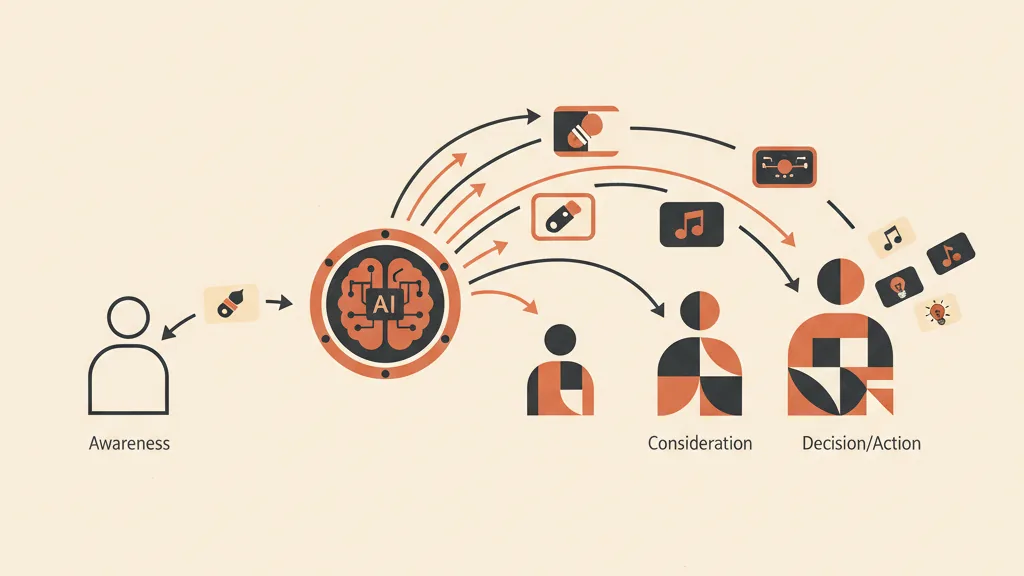
The funnel isn't dead: it moved up a level
Here's the distinction that settles the debate. Today the funnel operates on two different layers, and conflating them is the mistake that leads people to either declare it dead or defend it out of habit.
Layer 1: campaign structure (where the AI wins)
Here, in 2026, the trend is clear: fewer campaigns, more consolidation. A single Advantage+ campaign with concentrated budget almost always beats three micro-budgeted funnel campaigns, for small and mid-sized accounts. You let the algorithm do the sorting work you used to do yourself with audiences. If you run an ecommerce store, this matters even more: automation has access to purchase-intent signals you simply can't see.
Layer 2: creative and messaging (where you still win)
Here the funnel is very much alive. Even if the algorithm mixes audiences together, the people who see your ad are still at different stages of awareness. Someone who doesn't know you needs a different message than someone who has already seen your site. The fix is no longer to separate the audiences, but to separate the creative and let the algorithm match the right message to the right person.
In practice: inside the same consolidated campaign, you upload TOFU creative (educational, problem-first), MOFU creative (proof, comparison), and BOFU creative (offer, guarantee). By testing, the algorithm works out on its own which creative performs with which type of person. The funnel shifts from the campaign level to the creative level. It's exactly the reasoning behind the five levels of customer awareness model: it's not the audience you segment, it's the message.
When it's still worth structuring the funnel explicitly
Consolidation isn't a dogma. There are specific cases where separating the stages is still the right call:
| Situation | Recommended structure | Why |
|---|---|---|
| High budget (several thousand euros a month or more) with lots of data | Explicit funnel is viable | Each tier gathers enough conversions to exit the learning phase |
| Long sales cycle (B2B, high ticket) | Separate MOFU and BOFU are useful | Nurturing requires sequenced messaging that AI alone doesn't orchestrate |
| Complex product that needs explaining | Dedicated educational TOFU | You need awareness volume before conversion makes sense |
| Retargeting with a specific offer (abandoned cart) | Separate BOFU, almost always | The message is different enough to justify a dedicated audience |
| Low budget, simple catalog, ecommerce | Consolidation (no explicit funnel) | Fragmenting kills performance; better to let the algorithm handle it |
The practical rule: the more data you have and the longer your sales cycle, the more an explicit funnel makes sense. The less data you have and the more impulse-driven the purchase, the more it pays to consolidate. B2B with appointments to close sits at the "explicit structure" end; impulse ecommerce sits at the "let the AI handle it" end.
If your case is B2B lead generation, the funnel doesn't end at Meta Ads: it continues in the CRM. A TOFU lead who fills out a form needs to be nurtured differently from one who arrived via BOFU retargeting. We cover this in detail in our lead generation funnel piece and in how to integrate CRM and sales funnel, because there the awareness stage drives the entire follow-up sequence.
Want to know if your Meta account is fragmenting the budget or starving the algorithm of data? Request an analysis of your campaigns and we'll tell you where you need structure and where it pays to let the AI handle it.
The hybrid approach we recommend for 2026
Here's the structure we use with most clients. It's neither the classic funnel nor blind automation:
- Consolidate the structure, segment the creative. One main Advantage+ campaign with concentrated budget. Inside it, a mix of creative covering every awareness stage. You let the algorithm match message to person.
- Keep exactly one explicit tier: warm retargeting. A dedicated BOFU campaign for people who added to cart, visited key pages, or abandoned checkout, with an offer or message that removes the last objection. It's the one "funnel tier" that almost always justifies separation, because the message is too different.
- Feed the algorithm quality data. With third-party cookies going away, optimization depends on the signals you pass it. Conversions API and offline conversions from the CRM aren't optional: they're what lets the AI reconstruct the funnel for you. Feed it dirty data and no structure will save you.
- Measure against the funnel, not the campaign. Even when campaigns are consolidated, KPIs still stay layered: cost per awareness result, consideration rate, final cost per acquisition. The funnel mental model is what lets you read the right KPIs, even when the structure no longer mirrors them one to one.
Note that in this model the funnel hasn't disappeared: it has become a lens for reading results and a criterion for building creative, no longer an architectural constraint. That's exactly the transformation automation has forced, and once you understand it, you stop arguing over "funnel yes" versus "funnel no."
Mistakes to avoid in either approach
- Fragmenting the budget "out of respect for the funnel." If you split 900 euros a month across three campaigns of 300, none of them exits the learning phase. Better to put the full 900 into one well-structured campaign.
- Consolidating and never retargeting. The opposite extreme: dumping everything into one broad campaign and ignoring people who were already one step from buying. Warm BOFU remains the piece that pays off the most.
- Using the same creative for every stage. If you only run "buy now" ads, you cut out the entire cold audience. If you only run educational ads, you never close. You need the mix.
- Not feeding conversion data to the algorithm. Without good Event Match Quality, the AI optimizes blind and no structure works.
- Judging TOFU on immediate ROAS. Awareness creative doesn't close on the first click. Kill it because "it doesn't convert" and you drain the top of the funnel, then a month later you're wondering why retargeting has nobody left to recover.
That last point is the most underrated. The funnel, even in its algorithmic form, remains a system: cut off the feed at the top and the bottom runs dry a few weeks later. It's why measuring everything on 7-day ROAS leads you to the wrong calls. It's also worth reading why a funnel often fails to convert — usually not because of a structural problem, but because of what's feeding it upstream.
Bottom line: mental structure yes, cage no
The TOFU MOFU BOFU funnel isn't dead, but it isn't immortal either. It has become something different from what it was. As a way of thinking about awareness, message, and sequence, it remains indispensable and will still be five years from now, because it describes the psychology of buying, not a Meta feature. As an architecture of separate campaigns on fragmented budgets, in 2026 it's almost always the wrong choice for a small or mid-sized account.
The right question isn't "funnel or no funnel." It's: where do I put structure, and where do I let the algorithm decide? Structure in the creative and in warm retargeting. Freedom for the AI in sorting the audience. Clean data holding it all together. That's the funnel that works today.
Frequently asked questions
Is the TOFU MOFU BOFU funnel still valid in 2026?
Yes, as a mental model for building messages and sequences, because it describes the psychology of buying. No, as a rigid structure of three separate campaigns on fragmented budgets: with Advantage+, it's almost always better to consolidate and segment the creative rather than the audiences.
Is a consolidated Advantage+ campaign better than the three-stage funnel?
For small and mid-sized accounts with limited budget, a consolidated campaign almost always beats three micro-budgeted funnel campaigns, because it avoids fragmenting conversion data. An explicit funnel makes sense only with a high budget, lots of data, or a long sales cycle like B2B.
Do I still need to retarget if I consolidate everything?
Yes. Warm retargeting (abandoned cart, key page visitors) is the one funnel tier that almost always justifies a separate campaign, because the message is too different from the one aimed at a cold audience. It's also the piece that pays off the most.
How do I apply TOFU MOFU BOFU inside a single campaign?
You move the funnel from the campaign level to the creative level: inside the same campaign you upload educational ads (TOFU), social-proof and comparison ads (MOFU), and offer- or guarantee-based ads (BOFU). The algorithm matches the right creative to the right type of person.
Why isn't my three-campaign funnel performing?
Usually because you're fragmenting the budget: splitting spend across three small campaigns means none of them gathers enough conversions to exit the learning phase (roughly 50 events a week). You need to concentrate the budget or feed the algorithm cleaner conversion data via Conversions API.
Does the funnel change for B2B lead generation?
Yes. In B2B the cycle is long and the funnel doesn't end at Meta Ads: it continues in the CRM. A TOFU-stage lead needs different nurturing from a BOFU lead, so here separating the stages and integrating with the CRM stay far more relevant than in impulse ecommerce.
If you want a funnel that feeds the algorithm the right data and continues into the CRM, let's talk: we'll analyze your case and build the hybrid structure that fits your budget.