Ecommerce Lead Generation: Capture Customers, Not Just Sales
7 min read · AstraLoop Studio
Ecommerce lead generation is how an online store captures contacts (email and phone) before and beyond the single sale, so it can sell to the same person again and again over time. Most ecommerce brands do the exact opposite: they spend on traffic, chase the immediate conversion, and let everything else slip away. 97% of visitors don't buy on their first visit. If you don't capture their contact info, that ad spend is burned.
The point is simple. A customer is a single event. A contact is an asset you can reactivate at close to zero cost. Anyone thinking purely in terms of today's orders pays the highest CPA in the industry. Anyone building a list drives down acquisition cost with every subsequent purchase.
Why the sale isn't enough (and the contact is)
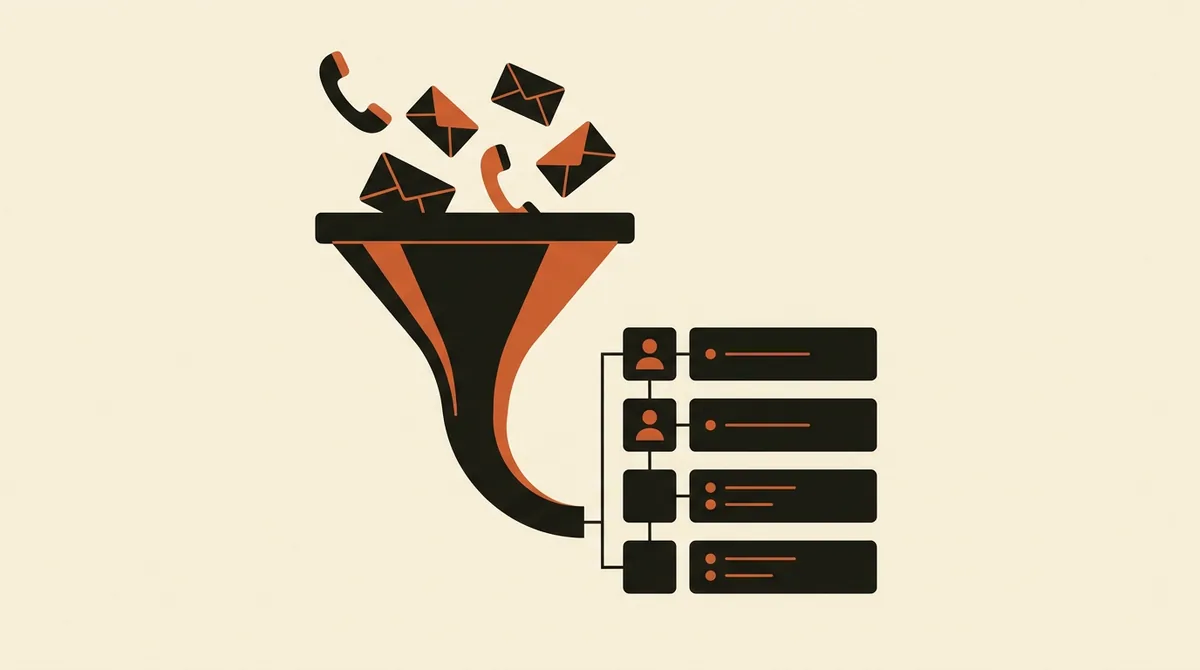
Picture your store as a leaky funnel. A hundred people walk in, two buy, and the other 98 disappear. Tomorrow you have to buy traffic all over again just to see them once more. It's the most expensive model there is.
Lead generation plugs the leak. It turns those 98 visitors into contacts you can reach whenever you want, at close to zero marginal cost. It moves two numbers that decide whether an ecommerce business is profitable or not:
- CAC (customer acquisition cost): by capturing the email before the sale, you convert through nurturing instead of paying for a second paid click.
- LTV (customer lifetime value): a contact on your list buys 2, 3, 4 times. The first order often breaks even or loses money. The profit comes from the second order onward.
If you're not sure of the difference between a simple subscriber and a contact ready to buy, start with what a qualified lead is (MQL vs SQL). In B2C the concept works differently than in B2B, and we cover that in our guide on how B2C lead generation works.
List building: capturing the contact before checkout
This is the biggest gap in most standard guides. Almost all of them assume you already have a list. But the list has to be built, and the best moment to do it is before the visitor leaves.
Don't ask for the email cold. Give something in return. A lead magnet in ecommerce isn't a boring ebook, it's a concrete incentive:
- Welcome discount (10% off the first order in exchange for the email is still the most effective).
- Free shipping above a threshold, unlocked by signing up.
- Quiz or configurator ("find the right product for you") that collects the email and, at the same time, useful data for segmentation.
- Waitlist for a product that's running low or an upcoming drop.
Format matters as much as the offer. Multi-step popups convert better than single-step ones: first ask for a small commitment (want your discount?), then the email. And collect the phone number too where it makes sense: SMS opt-in is gold, since it opens a channel with open rates email can only dream of. Watch out for GDPR: consent for promotional communications must be explicit and traceable.
Rule of thumb: every euro spent on ads without a contact-capture system is a euro you pay twice. Once to bring them to the site, again to reach them a second time.
Where the ad ends and the system begins
The platforms that generate traffic and the pages where it lands decide half the outcome. A well-targeted ad landing on a weak page captures zero contacts. It's worth taking care of both sides.
We have two dedicated guides on this: lead generation with Facebook and Instagram Ads, which do the heavy lifting in B2C, and lead generation with Google Ads to intercept people already searching for your product. But traffic alone isn't enough: you need a landing page built to capture the contact, not just any storefront page.
Cart recovery: the hottest lead you already have
About 7 in 10 carts are abandoned before checkout. But an abandoned cart isn't a lost sale: it's a red-hot lead who already gave you their email and put the product in the cart. It's the closest a contact will ever get to buying without actually buying.
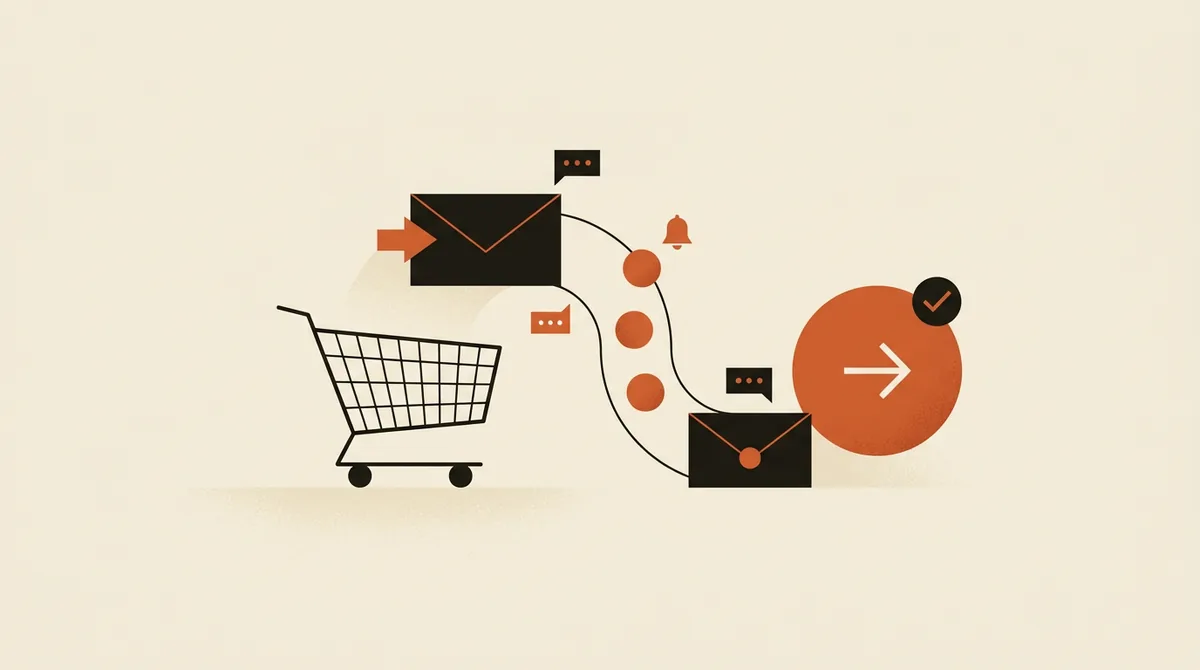
A well-built recovery sequence works like this:
- Email 1, after 1-4 hours: a simple reminder, with a photo and name of the product left in the cart and a direct CTA. No discount yet.
- Email 2, after 24 hours: add urgency ("your cart is about to expire", limited stock).
- Email 3, after 48-72 hours: if needed, the incentive (discount or free shipping) to close the deal.
Add an SMS between the second and third step, where you have consent, and the numbers go up. A well-structured cart flow generates the highest revenue per recipient of any ecommerce automation. It's the first system to activate, always.
From the first order to LTV: where the real profit is
Capturing the contact is half the job. The other half is getting them to come back. The classic mistake is treating the relationship as closed after the first purchase. That's actually where it should start.
Post-purchase automations raise LTV without spending an extra euro on advertising:
- Welcome series: the first few days after signup have the highest engagement. Tell the brand story, make the first cross-sell.
- Post-purchase and replenishment: if you sell consumables, an email at the right moment ("running low?") brings the order back on its own.
- Win-back: anyone who hasn't bought in 60-90 days needs to be reached before they go cold for good.
- Segmentation: people who bought once, people who bought three times, people who only clicked. Treating them all the same wastes the list.
This is where you see the difference between those who think in terms of sales and those who think in terms of relationships. For the full picture of how contact collection and conversion are structured, the master guide is our complete guide to lead generation, and you'll find the step-by-step mechanics in the lead generation funnel.
Want a system that captures contacts and reconverts them automatically, instead of burning budget on ads? Let's talk with AstraLoop: we'll build your ecommerce lead generation engine.
How much does an ecommerce lead cost (and how to keep it low)
Cost per lead in B2C ecommerce is usually lower than in B2B, but the logic is the same: what matters isn't the standalone CPL, it's the ratio between contact cost and the value it generates over time. A €2 lead who buys three times beats a €0.50 lead who never comes back.
The main levers for lowering it:
- High-perceived-value lead magnets (a real discount converts better than a generic ebook).
- Popups and forms optimized for format and timing, not placed at random.
- Automations that do the conversion work for you, 24/7.
- Segmentation that avoids burning out the list with undifferentiated sends.
For real benchmarks, we've gathered the data in how much a lead (CPL) costs by industry. And if you're collecting plenty of contacts but few are buying, the problem is upstream: read how to qualify leads.
Where AI comes in (and why it makes the difference)
Building all of this by hand is possible, but slow. Automation and AI change the scale: dynamic popups that change the offer based on behavior, sequences that adapt to whoever receives them, segmentation that updates itself, churn predictions that let you reactivate before it's too late.
This isn't theory. At AstraLoop we've been combining AI and automation with lead generation for years: over 370,000 qualified leads generated, more than 140 automated systems built, €1.2 million in ad spend managed with an average growth of 210%. The advantage isn't "using AI," it's connecting it to a system that collects, qualifies, and reconverts contacts automatically.
If you want to understand the mechanics, start with lead generation with AI and dig into AI agents for lead generation. And if you'd rather have it built by people who do this for a living, here's what it means to work with an AI lead generation agency.
In practice: where to start
You don't need to do everything at once. The right order is this:
- Turn on contact capture (popup with lead magnet) before you even scale your ads.
- Set up the cart recovery flow: it's the fastest ROI you'll get.
- Build the welcome and post-purchase series to start working on LTV.
- Segment and win back, then optimize CPL and conversions.
A sale is a moment. A contact is the engine that generates repeat sales. An ecommerce brand that collects and nurtures contacts stops depending on paid traffic and starts owning its audience. That's where the math finally works out.
Frequently asked questions
What's the difference between a sale and lead generation for an ecommerce store?
A sale is a single event: an order comes in and that's it. Lead generation captures the visitor's contact (email or phone), even from people who don't buy right away. That lets you reach them again at close to zero cost and sell to them multiple times over, lowering acquisition cost and raising LTV.
What's the most effective way to collect emails in my online store?
A popup with a lead magnet is still the most effective: offer something of real value (welcome discount, free shipping, quiz) in exchange for the email. Multi-step popups convert better than single-step ones. Where it makes sense, collect the phone number too to activate the SMS channel, always with explicit GDPR consent.
Is cart recovery lead generation or email marketing?
Both. An abandoned cart is an already-hot lead who gave you their email and showed purchase intent. A sequence of 2-3 emails (plus an optional SMS) recovers a meaningful share of sales that would otherwise be lost, and it's the flow with the fastest return, so it should be the first one you activate.
Why does LTV matter more than the single sale?
Because the first order often breaks even or loses money, covered by the cost of advertising. The profit comes from the second purchase onward, when you reach a contact already on your list without paying for new traffic. Maximizing LTV with post-purchase automation is what makes an ecommerce business profitable.
Do you need AI to do lead generation for an ecommerce store?
It's not mandatory, but it changes the scale. AI and automation enable dynamic popups, sequences that adapt to behavior, automatic segmentation, and churn prediction. The real advantage isn't using AI for its own sake, it's connecting it to a system that collects, qualifies, and reconverts contacts without manual work.
If you want to turn your online store's traffic into a list of customers who buy again and again, email us at astraloopstudio@gmail.com. Let's design your lead generation and automation system together.