Customer Acquisition System vs Lead Generation: The Key Differences
10 min read · AstraLoop Studio
There's a confusion that costs many Italian entrepreneurs dearly: thinking that a "customer acquisition system" and "lead generation" are synonyms. They're not. They are two different ways of getting customers, with different economics, different risks and different levels of control. Confusing them leads you to pick the wrong tool, sign contracts that tie your hands, or burn money on contact lists you'll never close.
The difference in one line: lead generation is an activity (generating interested contacts), the acquisition system is an asset (an owned machine that generates customers predictably and repeatably). One is a part, the other is the whole engine. In this article we look at where one ends and the other begins, when it makes sense to buy leads and when you need to build the system instead, with concrete numbers and criteria to help you decide.
Clean definitions: what these things really are
Let's start with the terms, because Italian marketing uses them interchangeably, and that creates the wrong expectations.
Lead generation: the activity of generating contacts
Lead generation is the set of tactics that turn a stranger into an interested contact: someone who has left an email or phone number, filled out a form, replied to a cold email, or raised their hand. It's a specific activity, measurable through a cost per lead (CPL) and a volume. You do it with Meta Ads, Google Ads, cold email, LinkedIn, SEO. The result is a list of people who, in theory, have shown interest.
Here's the thing: lead generation stops at the contact. What happens next (who qualifies the lead, who calls back, who nurtures it, who closes it) isn't part of the definition. That's exactly where a lot of activity falls through the cracks.
Customer acquisition system: the complete machine
The customer acquisition system is the integrated set of components that takes a stranger all the way to becoming a paying customer, predictably and repeatably. Lead generation is one of its parts, not the whole thing. A complete system includes at least:
- Traffic or contact source: paid, organic, cold outreach, referrals.
- Capture mechanism: landing pages, forms, response sequences.
- Qualification: the filter that separates leads that are ready from the ones that waste your time.
- Nurturing and follow-up: the sequence that warms up whoever isn't ready yet.
- Booking and sales: setters and closers who bring the contract home.
- Measurement: data on every step, from the first contact to revenue.
Put plainly: lead generation gives you the fuel, the system is the car. Fuel alone won't get you anywhere.
The difference nobody explains to you: ownership vs pay-per-use
This is the core of it, and it's ground almost nobody covers in Italy. The real question isn't "do I generate leads or build a system", but who owns the asset.
The "pay-per-lead" model
Most lead generation agencies sell you leads by the contact: you pay X euros for every qualified contact they hand you. It sounds convenient, and in some cases it really is. But it has specific traits:
- The leads aren't yours until you pay for them, and often the same leads get sold to multiple clients (especially in B2C: solar, insurance, real estate).
- The moment you stop paying, the flow stops. You haven't built anything that stays.
- The know-how (which messages work, which segments convert, how to warm up a contact) stays with the agency, not with you.
- The cost grows along with you: the more you want to grow, the more you pay. There's no economy of scale working in your favor.
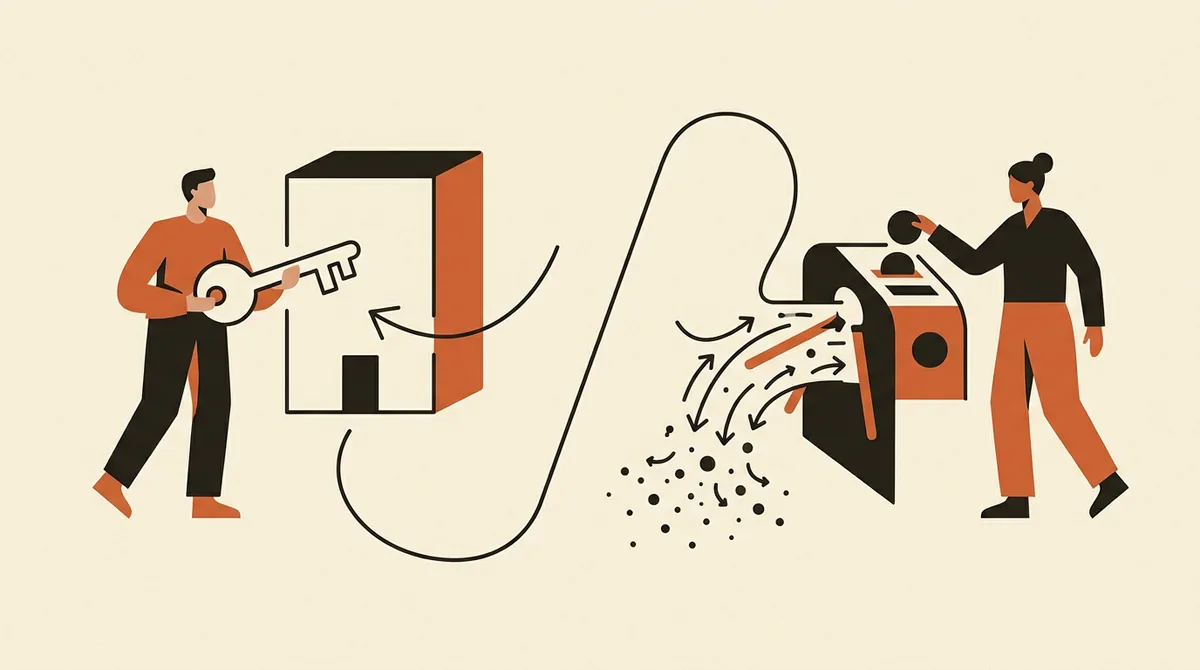
It's not inherently wrong. To test a channel, to fill gaps in the pipeline, for verticals where a lead has high, immediate value (an insurance policy, a 15,000-euro installation), buying leads makes sense. But you're renting acquisition, not owning it.
The "owned system" model
An owned acquisition system is a machine that stays yours. Domains, lists, email sequences, funnels, sales scripts, historical data: all of it stays inside your company even if you change vendor or partner. The traits are the opposite:
- The asset appreciates over time: the more data you collect, the better the system works.
- It requires an initial investment and a break-in period (usually 60-90 days before it runs stably).
- Once it's up to speed, the cost per customer tends to fall, not rise.
- It increases the value of the company: a business with a predictable, owned pipeline is worth more than one that depends on an outside agency.
If you're thinking about structural growth, or about selling the business one day, the difference between renting and owning acquisition is enormous.
| Aspect | Pay-per-lead generation | Owned acquisition system |
|---|---|---|
| What you buy | Contacts (output) | The machine that produces them (asset) |
| Who owns the asset | The agency | You |
| What happens if you stop paying | Flow drops to zero, immediately | The system keeps running |
| Exclusivity of contacts | Often shared | Total |
| Cost over time | Rises with volume | Tends to fall once up to speed |
| Time to get up to speed | Immediate | 60-90 days |
| Effect on company value | Null or negative (dependency) | Positive (predictable pipeline) |
| When it makes sense | Testing, pipeline gaps, verticals with high value per lead | Structural growth, predictability, exit |
Why "just leads" often isn't enough
Imagine you've bought 100 leads this month. What happens next? If you don't have a process behind it, most of them go cold within a few hours. The data on follow-up and qualification is brutal: a lead contacted again within a few minutes converts far better than one contacted the next day. Without a system that qualifies, calls back and warms up contacts, you've bought a list that loses value before your eyes.
This is where the difference between a qualified lead (MQL/SQL) and just any contact becomes clear. Lead generation brings you contacts. The system turns them into appointments and customers. A flow of leads with no qualification, no automated follow-up and no one to close them is like filling a bucket with holes in it.
The typical problem of the Italian entrepreneur: they buy leads, complain that "they're low quality", switch agencies and start over. Nine times out of ten, the problem wasn't the leads, it was the absence of a system to work them. Before pointing the finger at the source, ask yourself: how many of the leads I've already received have I actually worked all the way through?
When it makes sense to buy leads and when to build the system
This isn't an ideological choice, it's a choice about stage and unit economics. Here are the concrete criteria.
Buying leads makes sense if:
- You need to test a channel or an offer without committing to a long-term investment.
- You have pipeline gaps to fill right away and can't wait for a system to break in.
- You operate in a vertical where the value of a single lead is high and immediate (solar, insurance, car dealerships) and the CPL pays for itself easily.
- You don't yet have a solid internal sales process: buying leads gives you volume to train on.
Building the system makes sense if:
- You want predictable revenue: knowing that every month X appointments and Y customers come in.
- Your sales cycle is long and needs nurturing and multiple touchpoints (typical of B2B and services).
- You want acquisition to become a company asset, not an endless variable cost.
- You're growing and the pay-per-use model is starting to cost you too much per unit.
Many businesses do well to start by buying leads to test, and then reinvest what they learn into building their own system. These aren't rigid alternatives: they're two phases of the same customer acquisition strategy.
The numbers to decide with: unit economics
The decision should be made with numbers, not gut feeling. The three metrics that matter:
- CPL (cost per lead): how much a single contact costs you.
- CAC (customer acquisition cost): how much it costs you to bring home a paying customer, follow-up and sales included.
- LTV (customer lifetime value): how much a customer is worth over the entire relationship.
The rule of thumb is that LTV should be worth at least 3 times the CAC. If you buy leads at 20 euros and convert 1 in 10, your "raw" CAC is already 200 euros, before you even count the time spent selling. If a customer is worth 400 euros over their lifetime, the math doesn't work. If they're worth 4,000, it works just fine. To dig deeper into how to read these metrics, there's a dedicated guide on acquisition unit economics (CAC, CPL, LTV), and if you want to understand in detail how it's calculated and what really matters in a sensible cost per lead.
The central point: an owned system has a higher upfront cost but a CAC that tends to fall once it's up to speed. Pay-per-lead has zero upfront cost but a CAC that stays flat or rises. Do the math on your time horizon. If you're thinking about the next three months, pay-per-use can win. If you're thinking about the next two years, the system almost always wins.
Not sure whether you should buy leads or build your own acquisition machine? Tell us about your situation and we'll give you a concrete analysis, numbers in hand.
The role of AI: where it shifts the balance
Over the past two years, automation and AI agents applied to lead generation have lowered the cost of building an owned system. Things that used to require a whole team (multichannel outreach, qualifying replies, booking appointments) are now largely automated. This changes the math: building your own system costs less and gets up to speed faster than it did three years ago.
A concrete example: an AI prospecting agent can run sequences across multiple channels, qualify replies in real time and pass only the warm contacts to the human setter. The setter becomes a quality filter, not a switchboard operator. Watch out for the hype, though: AI doesn't replace strategy, it doesn't save a weak offer, and it doesn't make up for poorly executed technical deliverability. It's a powerful tool inside a well-designed system, not a shortcut.
On the deliverability front, if your system uses cold email, the technical side (domain warmup, configuring SPF, DKIM and DMARC, compliance with the new rules for bulk senders) isn't optional. It's the difference between landing in the inbox or in spam, and most Italian agencies treat it superficially. Whoever owns the system has to own this skill too, or rely on someone who has truly mastered it.
How to choose: the right question to ask yourself
Stop asking yourself "where do I buy the best leads". Ask yourself instead:
- Do I have a process that works the leads I already have? If not, you need a system more than you need more leads.
- What's my time horizon? The short term pushes toward pay-per-use, the medium-to-long term toward the system.
- Do I want an asset or a service? If you want something that stays yours and grows in value, go with the system.
- Do my numbers hold up? Calculate CAC and LTV beforehand, not after.
If what you need is a continuous, predictable flow rather than a one-off hit, the direction is clear: look at how to build a steady flow of customers instead of chasing spot leads. And if you want to understand how much it costs to set up a complete machine, there's a transparent breakdown on how much a customer acquisition system costs.
In short
Lead generation and an acquisition system are not the same thing, and they're not in competition: the first is a piece, the second is the whole machine. Buying leads means renting acquisition, building a system means owning it. Pay-per-use makes sense for testing and filling gaps. The system makes sense when you're after predictability, when your sales cycle is long, and when you want an asset that stays yours and grows in value. Decide with numbers (CAC, LTV, time horizon), not with trends. And remember that, almost always, the problem isn't the leads you receive: it's the absence of a system that works them all the way through.
Frequently asked questions
What's the difference between lead generation and a customer acquisition system?
Lead generation is the activity of generating interested contacts (one piece of the process). The acquisition system is the complete, integrated machine that takes a stranger all the way to becoming a customer: it includes lead generation, qualification, follow-up, sales and measurement. One is the ingredient, the other is the finished recipe.
Is it better to buy leads or build your own acquisition system?
It depends on the stage you're at. Buying leads makes sense to test a channel, fill pipeline gaps, or in verticals where a single lead is worth a lot. Building a system makes sense when you're after predictable revenue, have a long sales cycle, or want an asset that stays yours. Many start by buying leads and then reinvest in their own system.
Why do the leads I buy convert so poorly?
Nine times out of ten the problem isn't the leads, it's the absence of a system that works them. Without qualification, fast follow-up and a closer to close the deal, even good leads go cold within hours. Before switching sources, check how many of the contacts you've already received you've actually worked all the way through.
What does it mean that leads get sold to multiple clients?
In the pay-per-lead model, especially in B2C (solar, insurance, real estate), the same agency can resell the same contact to multiple competing companies. That means you're competing over a lead that isn't exclusive to you. In an owned system, the contacts are yours alone.
How long does it take for an acquisition system to get up to speed?
Usually 60-90 days before it runs in a stable, predictable way. That's the time needed to gather data, optimize messages and channels, and figure out which segments convert. It's the main downside compared to pay-per-lead, which produces contacts right away but without building anything lasting.
Does AI make buying leads pointless?
No, but it shifts the balance. AI agents lower the cost of building an owned system (multichannel outreach, qualifying replies, booking appointments), making it more accessible and faster. The cases where buying leads makes sense are still valid, but doing it yourself in a structured way now costs less than before. Watch out for the hype: AI is a tool inside a system, not a shortcut.
If you want to figure out which path is right for your business, talk to us: we'll analyze your numbers and tell you honestly what makes sense, no inflated promises.