How Much Does a Customer Acquisition System Cost? 2026 Pricing Models
7 min read · AstraLoop Studio
The question almost always shows up the same way: "How much does a customer acquisition system cost?" And the honest answer, the one few agencies will give you, is that it depends on what you're actually buying. Under the same label you'll find wildly different things: everything from a €40-a-month cold email tool subscription to a full machine, run by a team that brings you qualified appointments every week, for several thousand euros.
In this guide we put the numbers on the table. You'll see the real price ranges on the Italian market in 2026, the three main commercial models (one-off setup, monthly retainer, pay-per-performance) and how to figure out which one makes sense for your situation. No "guaranteed clients", no inflated figures: just what you need to sign a contract knowing exactly what you're paying for.
If you want to understand what we're actually talking about before we get to pricing, read the complete guide to the customer acquisition system first. Here we assume you already know it's a full machine, not a single tactic disconnected from everything else.
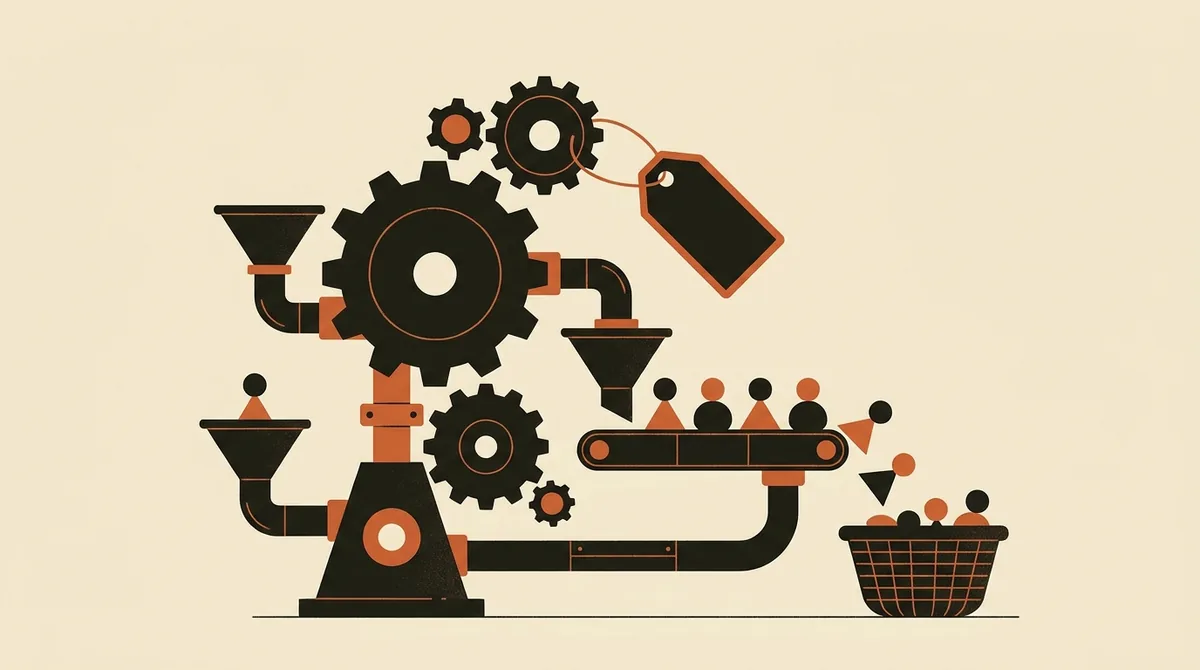
Why "how much does it cost" is the wrong question (and what the right one is)
Asking just the price is like asking "how much does a car cost". A hatchback and a work van cost different amounts because they do different jobs. It's the same with customer acquisition, and the trap is comparing quotes that look comparable but aren't.
The right question is different: how much does each new customer actually cost me, and how long until the system pays for itself? This is where unit economics come in: CAC (customer acquisition cost), CPL (cost per lead), LTV (lifetime value). If a system costs you €4,000 a month but brings in 6 customers worth €8,000 each, it's cheap. If it costs you €1,500 and brings in nothing, it's the most expensive thing you'll ever buy. I go into detail on this in the guide to acquisition KPIs and unit economics.
Before you look at price lists, keep three things in mind — they move the price more than anything else.
- Your average deal size. Selling a €500 service or a €20,000 consulting engagement calls for different systems. The higher the value, the more the system can afford to spend on acquiring it.
- The channels involved. Cold email alone is cheap. Cold email plus LinkedIn, plus paid advertising, plus a human setter qualifying leads costs a lot more, but covers more fronts.
- Who owns the asset. A system that's built and handed over to you (domains, sequences, CRM, lists) has a different cost structure than an agency that sells you leads on consumption and keeps everything in-house.
The three pricing models: how they actually work
Almost every offer on the market falls into one of these three models, or a combination of them. Let's go through them one by one, with the numbers.
1. One-off setup plus monthly retainer
This is the most common model for a turnkey system. You pay an upfront amount for the build (the setup) and then a monthly fee for ongoing management, optimization, and outreach volume.
What the setup covers: configuring sending domains, warmup, SPF, DKIM and DMARC settings, building target lists, writing sequences, setting up the CRM and automations, building the funnel and landing pages. It's the heavy lifting done once.
What the retainer covers: daily sending, deliverability monitoring, A/B testing messages, managing replies, reporting, and ongoing adjustments to lists and copy. It's the oxygen that keeps the machine running.
The upside: you build an asset that's yours, with predictable costs. The downside: you're still paying during the months when results are still ramping up, because no serious system runs at full capacity from day one. Realistic ramp time is 60-90 days.
2. Pay-per-performance (you only pay for appointments)
Here you don't pay for the work, you pay for the outcome: a fixed fee per appointment booked, or better, per "show" appointment — one the prospect actually turns up for. This is the performance-based appointment setting model.
The upside is obvious: the risk shifts to the provider. If they don't deliver, they don't get paid. That's why this is the model business owners ask for the most.
But watch out for three things. First, the cost per appointment is high precisely because the provider is taking on the risk: it isn't "free", it's a price that bakes in a premium for uncertainty. Second, you need to define precisely what counts as a valid appointment (industry, contact's role, company size), or you'll end up paying for meetings that go nowhere. Third, the real quality filter is a human setter who qualifies before booking: without one, a performance model risks rewarding quantity over quality.
3. Hybrid model: reduced base fee plus performance bonus
This is the compromise that seems to work best in 2026. A modest monthly fee covers hard costs (software, lists, sends) and keeps both parties aligned; on top of that, a variable bonus tied to appointments generated or deals closed. You're not paying a full retainer "blind", and the provider isn't working for free during the ramp-up months. It's the model I recommend when there's mutual trust but neither side wants to shoulder all the risk alone.

Real prices on the Italian market in 2026
These are indicative ranges. They're meant to help you tell whether a quote is in the normal range or way off, not to replace an analysis of your specific case. Prices vary a lot depending on industry, volume, and complexity.
| Solution | One-off setup | Monthly fee | Best for |
|---|---|---|---|
| Cold email software only (DIY) | €0 - 300 | €40 - 300 | Those with in-house time and skills |
| Freelancer / solo setter | €500 - 1,500 | €800 - 2,500 | Micro-businesses, first test |
| Turnkey system (agency) | €1,500 - 5,000 | €2,000 - 6,000 | B2B SMEs, services, consulting |
| Full-funnel integration (outbound plus paid plus organic) | €3,000 - 8,000 | €4,000 - 12,000 | Companies with high deal size |
| Performance (per show appointment) | €0 - 2,000 (base) | €120 - 400 / appointment | Those who want to shift the risk |
On the consumption-based model, the useful benchmark is cost per lead: in the Italian B2B market a qualified lead can range from a few tens to several hundred euros depending on the industry. A qualified "show" appointment naturally costs more than a plain lead, because it already includes the filtering work.
What a serious quote must include (and what low prices hide)
A low price is often not a bargain: it's a missing piece. Before you sign, check that the quote covers all of the following. If something's missing, the real cost is higher than the number on paper.
- Dedicated domains and warmup. No serious provider starts you off on your main company domain. You need secondary domains warmed up over weeks. Anyone who skips this step burns your email reputation.
- Deliverability configuration. SPF, DKIM and above all DMARC set to p=reject. With Google, Yahoo and Microsoft's 2025-2026 bulk sender rules (spam rate under 0.3%, bounce rate under 2%, mandatory one-click unsubscribe), skip this configuration and your emails land in spam while you pay for nothing. It's the number-one technical reason emails end up in spam.
- Target lists that are built, not bought. The value is in the targeting. A generic list bought online doesn't convert and puts you at risk of high bounce rates.
- Lead qualification. Who filters the replies? A serious qualification process tells a good appointment apart from one that just wastes your time.
- Transparent reporting. You need to see real numbers — sends, opens, replies, appointments, shows — not a slide at the end of the month with only the flattering metrics.
The role of AI here matters, but it should be read without the hype. An AI agent for lead generation cuts the cost of mass outreach and initial qualification, but it doesn't replace human judgment on the accounts that actually matter. The most effective split is AI on volume, humans on quality.
Want to know which pricing model actually makes sense for your deal size and your industry? Request an analysis: we'll give you real numbers, not promises of guaranteed clients.
Setup plus retainer or performance: which one is right for you
There's no single "best" model. There's the right one for your stage. Here's how to think about it.
Choose setup plus retainer if...
- You want to build an owned asset that stays yours even if you switch providers.
- You have a repeatable sales flow and want to make it predictable over time.
- You can sustain 2-3 months of ramp-up before full output without stressing about it.
- Your goal is a steady flow of customers, not a one-off spike.
Choose performance if...
- You want to test a new channel while minimizing upfront risk.
- You have a strong in-house sales team and just need fuel at the top of the funnel — appointments.
- Your average deal size is high enough to absorb a higher cost per appointment.
For most B2B SMEs selling services or consulting, the hybrid model is the sweet spot: a modest base plus a bonus on results. If you're weighing whether to hire someone, the guide on choosing a B2B customer acquisition agency will help you ask the right questions.
A mistake to avoid: buying tactics instead of a system
The fastest way to burn through budget is buying disconnected pieces: a cold email campaign here, advertising there, a freelancer on LinkedIn doing their own thing. Each piece works at half-strength because none of them talks to the others. A real system unites outreach, funnel, and qualification into a single measurable machine — that's the difference between an acquisition system and plain lead generation.
When you compare quotes, don't just look at the number at the bottom. Look at what goes into the machine, who owns it in the end, and how long it's expected to take to pay for itself. A pricier system that you actually own, with transparent numbers and a realistic ramp, will almost always cost less than a "cheap" one that leaves you dependent for life on leads bought by the piece.
In short
In 2026, a customer acquisition system costs an Italian B2B SME roughly €1,500-5,000 in setup and €2,000-6,000 a month in management for a turnkey solution, or €120-400 per appointment under a performance model. The number to watch isn't the monthly price — it's the cost per customer acquired and the payback time. Always ask what the quote includes, who owns the asset, and which metrics you'll be measured against: that's where you find out whether you're buying a system or just a promise.
Frequently asked questions
How much does a customer acquisition system typically cost in Italy in 2026?
For a B2B SME, a turnkey solution typically costs €1,500-5,000 in initial setup plus €2,000-6,000 a month in management. A performance-based model runs around €120-400 per show appointment. These are market ranges: the actual price depends on industry, volume, and channels involved.
Is it better to pay a setup plus retainer, or pay purely on performance?
Setup plus retainer makes sense if you want an owned asset, predictable costs, and can sustain 2-3 months of ramp-up. The performance model makes sense if you want to minimize upfront risk and already have a strong in-house sales team. For most B2B SMEs, the sweet spot is the hybrid model: a modest base fee plus a bonus on results.
Why can a too-cheap quote end up costing me more?
A low price usually hides a missing piece: dedicated domains and warmup, deliverability configuration (SPF, DKIM, DMARC), lists that are built rather than bought, lead qualification, transparent reporting. If any of these is missing, the real cost is higher than the number on paper, because emails land in spam or the appointments turn out low quality.
What must a serious quote always include?
Dedicated, warmed-up sending domains, full deliverability configuration, target lists built around your ideal customer profile, a lead qualification process, and reporting with real numbers: sends, opens, replies, appointments booked, and appointments shown. If a quote doesn't mention these, ask explicitly who's handling them.
How do I know if I'm paying the right price?
Don't look at the isolated monthly cost — look at the cost per customer acquired (CAC) and the payback time. A system that costs more but brings in high-value customers is cheap; one that costs little and produces nothing is the most expensive option. Always compare who ends up owning the asset and which metrics you'll be measured on.
Does AI make a customer acquisition system cheaper?
Yes, but it doesn't replace everything. An AI agent cuts the cost of mass outreach and initial qualification, letting you work more volume at less cost. Human judgment, though, is still needed on the accounts that really matter. The most effective formula is AI on volume, people on quality.
If you're weighing a quote and want an honest second opinion on what it includes and what it should cost, talk to us: we'll look at your specific case and tell you what's worth it.