Customer acquisition: the strategies that actually work (and the ones burning your budget)
9 min read · AstraLoop Studio
Customer acquisition is the part of marketing where budget gets burned without anyone noticing. Not because the channels don't work, but because almost nobody measures what actually works. So money keeps flowing into activity that looks alive but doesn't produce a single paying customer.
Most articles on this topic give you the usual list: SEO, email, social, referrals. All good, all "important." As useful as saying you need to eat less to lose weight: true, and useless.
Here we do the opposite. We tell you which customer acquisition strategies deliver measurable results, which ones burn budget in silence, and the real numbers on acquisition cost in 2026. With a sharp point of view, because on this topic half-measures cost you at the end of the month.
What customer acquisition really means (and why the textbook definition is useless)
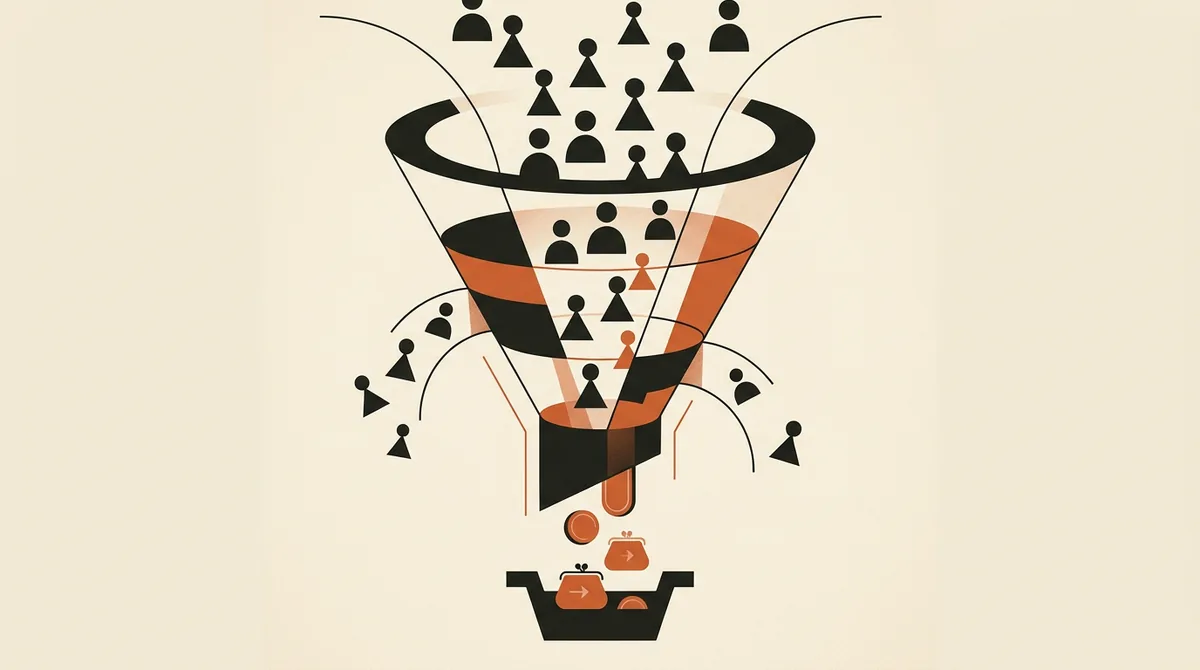
Customer acquisition is the process that turns a stranger into a paying customer: from the first exposure to your brand, to lead generation, through to conversion. That's the textbook part.
The problem is that this definition puts everything on the same level. A LinkedIn like and a signed contract end up in the same funnel as if they weighed the same. They don't.
Acquiring a customer isn't an event, it's a chain, and every link has a drop-off rate. If you don't know at which link you're losing people, you're optimizing blind. That's true whether you sell software to a company, run a car dealership waiting for customers in the showroom, or an e-commerce store losing carts at checkout. Before talking about channels, you need to understand how the numbers move along the journey: we covered that in detail in the lead generation funnel and the stages that matter.
The customer acquisition strategies that actually work
There's no universal strategy, but there are principles that hold in almost every context, whether you sell to a business or to an end consumer. Here they are, from the most underrated to the most overused.
1. Narrow the target until it almost hurts
Mistake number one is talking to everyone with the same message. The tighter your audience, the lower your customer acquisition cost drops. It sounds like a paradox: talking to fewer people should bring fewer customers. In reality it brings customers who convert.
A generic message costs in impressions and doesn't close. A surgical one costs less per lead and closes more. Think of a gym: a campaign promising "fitness for everyone" gets lost in the noise, while one for "moms who want to get back in shape without giving up two evenings a week" fills up classes. Precision is the cheapest CAC lever you have, and it doesn't cost a single extra euro in budget.
2. SEO and content that intercept intent
SEO brings traffic from people already searching for a solution to the problem you solve. It's the channel with the lowest marginal cost over time: a piece of content that ranks keeps working for months without you having to pay for it again.
We're not talking about writing random articles, but about intercepting the right queries, the ones from people one step away from deciding. An article ranking for "how to choose [your category]" is worth more than ten viral posts that don't bring anyone ready to buy. A real estate agency ranking for "how much is my house worth in [area]" intercepts people already thinking about selling, not just browsing.
3. Targeted outbound: cold email and LinkedIn
When waiting to be found isn't enough, you go to the customers yourself. B2B outbound, meaning cold email and direct LinkedIn outreach, remains one of the channels with the best control over volume: you decide how many prospects to reach today, without waiting on Google. The difference between the two channels isn't trivial, and the choice changes the results: we covered it in cold email vs LinkedIn for B2B lead generation.
4. Referrals and structured word of mouth
Word of mouth is the channel with the lowest CAC by far and the highest close rate. A customer who arrives through a referral already trusts you before you've even spoken. The problem is almost nobody structures it: they leave it to chance and hope for the best. An explicit referral program, with a clear incentive (a discount for anyone who brings a friend to the gym, a free month for the customer who refers a company), turns a stroke of luck into a repeatable channel.
5. Paid advertising (with judgment)
Ads work, but they're the only channel where the tap shuts off the exact instant you stop paying. Great for accelerating and testing, dangerous as your only source. If 100% of your customers come from paid, you don't have an acquisition system, you have a rental. And the rent goes up every year.
The best channel isn't the one that brings the most leads, it's the one that brings the most customers at the lowest cost and doesn't collapse if you cut the budget for a week.
The strategies that burn budget (and look like healthy activity)
Here's the part other articles avoid, because it's easier to list nice things than to take apart habits. Let's look at where acquisition budget evaporates without a trace.
- Paid ads with no upfront qualification. You fill the funnel with contacts sales will never close. You pay for the click, you pay for the salesperson's time, and you don't close. Double cost, zero revenue.
- Volume as the success metric. "We generated 500 leads this month." And how many were real buyers? A big number feels good and hides the disaster. Before scaling volume, learn to qualify leads without wasting time on cold contacts.
- Vanity metrics on social. Followers and likes that never turn into pipeline. Great for the ego, invisible on the balance sheet. An e-commerce store with 50,000 followers and few sales knows this well.
- Redoing everything every quarter. Switching channels before a test has enough data. Every restart wipes out the learning and doubles the cost.
- Measuring only paid. This is the sneakiest mistake, and we'll get to it shortly because it deserves its own section.
The common thread is one: acquiring without filtering. Pouring traffic into the top of the funnel with no mechanism to separate buyers from people who are just looking. If you recognize yourself in even one point on this list, you don't have a budget problem, you have a system problem.
Want to understand which acquisition channels are actually working for your business, and which ones are burning budget without you noticing?
Customer acquisition cost (CAC): the numbers that matter in 2026
Customer acquisition cost, or CAC, is how much you spend on average to turn a potential contact into a paying customer. The formula is simple:
CAC = (marketing spend + sales spend) ÷ number of customers acquired in the period
Simple to calculate, brutal to read when you do it properly. Because almost nobody puts all the costs in: salaries, tools, the salesperson's hours. A CAC calculated halfway is a lying CAC, and it makes a channel that's bleeding you dry look healthy.
Three 2026 numbers to keep in mind:
- CAC has risen 40-60% since 2023. More competition, stricter privacy rules, rising ad costs. The same ads that cost X two years ago now cost far more for the same result.
- A healthy LTV:CAC ratio is at least 3:1. For every euro spent acquiring, the customer should generate at least three over their lifetime. Below 3:1, you're buying revenue at a loss. That holds for a gym membership just as much as for the average value of a customer who keeps buying from your e-commerce store.
- CAC varies enormously by channel. In B2B, organic search remains far cheaper than paid, and a lead from LinkedIn ads can cost 30 times one from TikTok. An "average" company-wide CAC hides both the virtuous channels and the ones hemorrhaging money.
Want the full picture by industry, with Italian figures? You'll find it in how much a lead costs: cost per lead by industry in Italy.
The gap almost everyone has: measuring only paid
This is the single most useful data point in this entire article, and you won't find it elsewhere. Blended CAC, meaning the real acquisition cost averaged across all channels, is typically 2.4-3.1 times lower than paid CAC alone.
Translation: non-paid channels (organic, referral, word of mouth, content) bring in 60-70% of your customers. But most dashboards only measure paid, because it's the only one with easy, immediate numbers.
There are two consequences, both costly:
- You overvalue paid and keep pouring budget into it, because it's "the only one you see converting."
- You undervalue organic and content, which are quietly doing most of the work, and you cut them when it's time to save money. You cut exactly what's costing you the least.
If you only measure what's easy to measure, you optimize toward the wrong channel. The fix isn't buying yet another tool: it's attributing customers to every touchpoint, not just the last paid click. Ask any local shop that spends on ads but closes half its sales thanks to people who walked by and had already heard about it.
B2B and B2C customer acquisition: why the rules change
Most content online treats customer acquisition as one single pot. But B2B and B2C play two different sports.
In B2B the sales cycle is long, the purchase is rational, and it involves multiple people. You don't buy with a cart: you buy with a shared decision, often after weeks. In B2C, on the other hand, the decision is often individual and faster, but driven by emotion, price, and immediate trust. A clothing e-commerce store or a gym close the deal in minutes, not months. This changes the priorities.
- In B2B, lead quality matters more than volume. A qualified lead (MQL, SQL) is worth ten cold contacts.
- Content needs to educate, not just attract. Someone evaluating a B2B purchase wants to understand before talking to a salesperson; someone buying as a consumer wants reassurance before clicking "buy."
- Targeted outbound works in B2B, because you know the decision-maker and can reach them directly. In B2C, the equivalent lever is retargeting and social word of mouth.
If you work in B2B, your starting point is our pillar guide: B2B lead generation, the complete guide to acquiring qualified customers. And if you want seven concrete, ready-to-use approaches, we've collected them in how to generate qualified B2B leads: 7 strategies that work.
The role of AI and automation in lowering CAC
This is where most articles stop at a generic "AI helps." Let's look at how, with a concrete figure: advertisers using AI maturely report a roughly 14% year-over-year reduction in paid CAC. Not because advertising costs less (it costs more), but because they test faster and waste less.
AI lowers acquisition cost at three specific points:
- Automatic qualification. It filters out cold contacts before they reach sales, so selling hours go only to people who can actually buy.
- Personalization at scale. Messages tailored to each prospect without writing them one by one by hand. That applies to the email to a corporate buyer just as much as to the right offer for a customer who abandoned their cart.
- Faster testing. More creative and copy variants tested in less time, so you find what converts sooner.
This is where our approach is different: we combine AI and automation with lead generation and marketing, instead of treating them as separate worlds. In practice, that means putting AI agents to work on lead generation to handle the repetitive part of the funnel. We go deeper into the full picture in lead generation with AI: how to automate customer acquisition. It's not theory: it's how we've generated over 370K qualified leads for more than 60 companies.
Where to start: system first, then budget
If you had to boil it all down to one principle: don't scale an acquisition process you haven't understood yet. Throwing budget at a leaking funnel is the fastest way to turn a small problem into a big hole.
The right order is this:
- Define who the right customer is. A narrow target, not "everyone."
- Measure the real, blended CAC. All the costs, all the channels, not just paid.
- Find your lowest-CAC channel and understand why it works.
- Put a qualification filter upfront, so budget only goes toward people who can actually buy.
- Then, and only then, scale what's already converting.
You don't need to be present on every channel. You need to do well on the ones that bring in customers at the lowest cost, and stop feeding the ones burning budget disguised as activity. Customer acquisition isn't a matter of how much you spend, it's a matter of how much you know about what you spend.
Frequently asked questions
What is customer acquisition?
It's the process that turns a stranger into a paying customer: from the first exposure to the brand, to lead generation, through to conversion. It's not a single event but a chain of steps, and each step has a drop-off rate that needs measuring, in both B2B and B2C.
How do you calculate customer acquisition cost (CAC)?
You divide the sum of marketing and sales spend by the number of customers acquired in the same period. Make sure to include all the real costs (salaries, tools, salesperson hours), otherwise the CAC comes out lower than it actually is.
What's a good ratio between CAC and customer value?
The healthy benchmark is an LTV:CAC ratio of at least 3:1: for every euro spent acquiring, the customer should generate at least three over their lifetime. Below 3:1, you're buying revenue at a loss.
Which customer acquisition strategies burn the most budget?
The most common ones: running ads without qualifying contacts upfront, measuring success by lead volume instead of real customers, chasing vanity metrics on social, and switching channels before a test has enough data. The common denominator is acquiring without filtering.
Is it better to invest in acquisition or retention?
Acquiring a new customer costs 5 to 25 times more than retaining an existing one, and it's far easier to sell to an existing customer. Acquisition remains necessary for growth, but it needs to be balanced with retention, otherwise you're filling a leaking bucket.
If you want to build a customer acquisition system that filters upfront and doesn't waste budget on contacts that never close, let's talk: tell us about your business and we'll tell you where to start.