What Is a Customer Acquisition System (and Why It's Not a Single Tactic)
9 min read · AstraLoop Studio
If you've already tried ads, cold outreach, a funnel bought from a course, or a LinkedIn consultant, and every time the result was "a few leads for a while, then nothing," the problem is almost never the tactic itself. The problem is that you're buying disconnected pieces of a machine that nobody ever assembled.
A customer acquisition system is exactly that: the assembled machine. Not a campaign, not a channel, not a tool. It's the integrated set of processes that takes a stranger from "has never heard of you" all the way to "signed and became a customer," in a way that's repeatable and measurable. In this article I'll explain what sets it apart from an isolated tactic, the 6 components it's made of, and how to tell whether what you have today is a system or just a collection of disconnected activities.
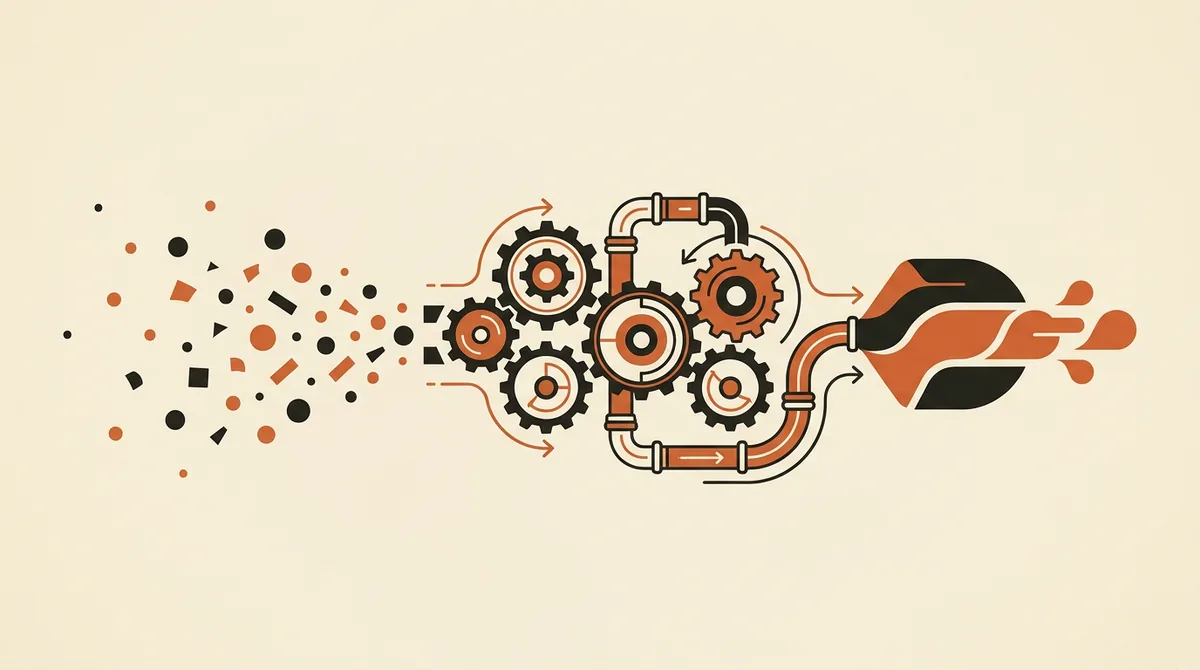
The difference in one sentence: tactic vs. system
A tactic is a single action that produces a local result. "I send 500 cold emails a week" is a tactic. "I run ads on LinkedIn" is a tactic. "I post twice a week" is a tactic. Each one can work, but it lives in isolation: it produces an output (a reply, a click, a like) that isn't automatically connected to whatever comes next.
A system is the orchestration of multiple tactics into a continuous flow, where the output of each stage feeds the next one without gaps. The cold email doesn't end at "they replied": the reply gets qualified, the meeting gets booked, the lead gets nurtured with targeted content, the deal gets managed, and the result gets measured with numbers that tell you what to fix. If any of these joints is missing, you don't have a system. You have a tactic with a hole downstream.
The acid test is simple. Ask yourself: "If I double the input at the top, does revenue at the bottom grow predictably?" If the answer is "eh, it depends, I can't really measure it," you have tactics. If the answer is "yes, at this CAC and on this timeline," you have a system. It's the same distinction I dig into when comparing a customer acquisition system versus plain lead generation: generating contacts is one phase, not the whole machine.
Why disconnected tactics leave you running on empty
The typical failure isn't dramatic, it's quiet. Here's how it plays out:
- The bottleneck just moves. You fix lead generation and suddenly sales is drowning in contacts it can't call back. You fix qualification and discover that qualified leads don't close because follow-up is chaotic. Every single tactic pushes the problem further downstream instead of solving it.
- You don't know where the revenue comes from. If ads, cold outreach, and word of mouth don't flow through the same measurable funnel, you can't say which euro spent produced which customer. You're optimizing in the dark.
- You depend on people, not processes. The star salesperson leaves and the pipeline collapses, because the knowledge lived in their head, not in the system.
- Revenue stays "lumpy." A good month, a bad month, with no idea why. That's the classic symptom of running on tactics instead of a predictable machine. If this sounds familiar, you need to understand how to build a steady flow of customers instead of chasing the next spike.
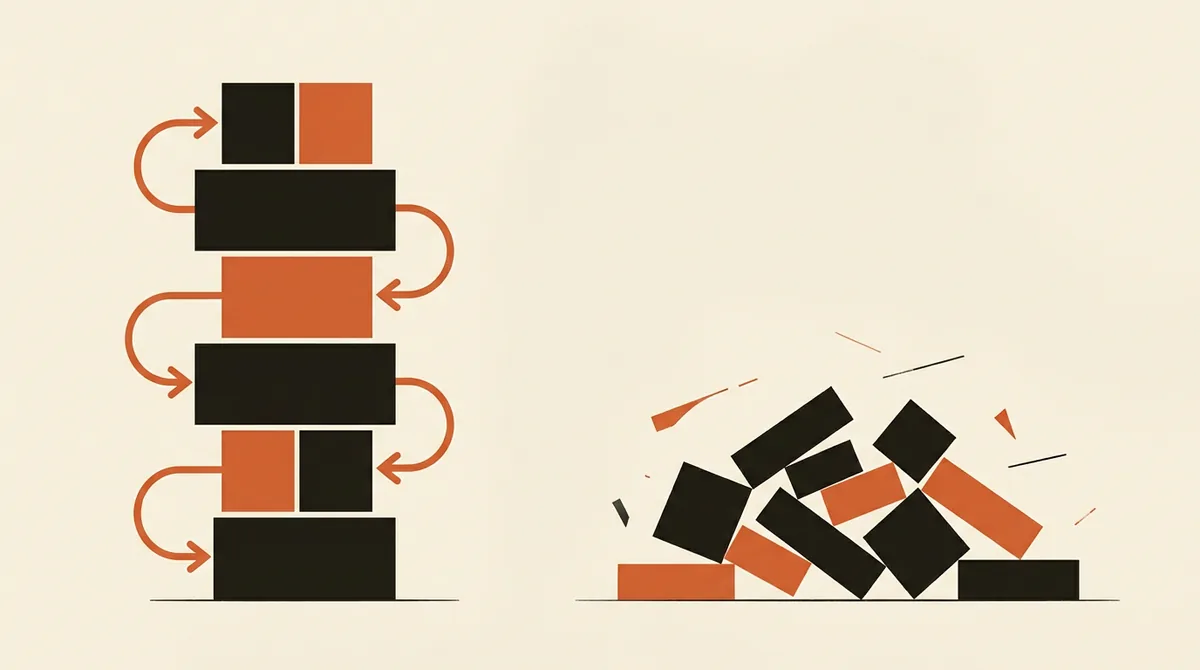
The point isn't that tactics are wrong. They're the right building blocks. But a pile of bricks isn't a house.
The 6 components of a customer acquisition system
A complete machine has six blocks. It isn't a rigid hierarchy (some run in parallel), but if one is missing the system fails. Here's the breakdown.
1. Demand source (the channels at the top)
Where attention comes from. This is where the channels live: outbound (cold email, LinkedIn, calls) and inbound (SEO, content, ads on Meta and LinkedIn, and today also getting cited by ChatGPT and Perplexity). It's not an either/or choice: a mature system integrates them in a full-funnel logic, where paid accelerates and organic compounds value over time. I break down the difference between the two approaches in inbound vs. outbound marketing in B2B.
2. Targeting and buying signals
Who you talk to and when. Mass cold blasting is dead: it burns your domain and reputation. A serious system uses signal-based selling, meaning it targets accounts showing real signals (a decision maker changing role, a new funding round, a new office opening, repeated visits to your site). Talking to the right person at the right moment is worth more than ten times the raw volume.
3. Deliverability and contact infrastructure
The most overlooked component, and the one that sinks the most campaigns. If your emails land in spam, the rest of the system is useless, because nobody reads the message. You need the technical foundations: domain warmup, properly configured SPF, DKIM, and DMARC authentication (with a DMARC policy set to p=reject), and compliance with the bulk sender rules introduced by Google, Yahoo, and Microsoft (spam rate under 0.3%, bounce rate under 2%, mandatory one-click unsubscribe). Skip this block and you'll soon find out why your emails end up in spam no matter how good the copy is.
4. Qualification and appointment setting
The filter. A reply isn't a lead, and a lead isn't a useful meeting. This is where qualification comes in (telling MQLs from SQLs apart, understanding budget, authority, real need, and timing) along with the work of the setter, who turns raw replies into meetings with people worth actually talking to. Increasingly, this block combines an AI SDR for first-touch multichannel contact with a human setter as the quality filter on replies. The performance-based model, where you only pay for actual meetings held, is born right here.
5. Nurturing and follow-up
Most customers don't buy on first contact. The system has to warm up the ones who aren't ready yet and disciplinedly re-engage anyone who said "let's talk again next month." Without automated sales follow-up, 60-70% of opportunities simply evaporate, because nobody called back at the right moment. This is also where reactivating your dormant database belongs: customers and contacts you already paid to acquire and are now letting go cold.
6. Measurement and unit economics
The dashboard that ties everything together. If you're not measuring, you don't have a system, you have a hope. The bare-minimum metrics are CAC, CPL, and LTV, plus the conversion rate between every stage (contact, reply, meeting, show, offer, closed). These are the numbers that make revenue predictable and tell you exactly where the system is leaking. A realistic ramp time, by the way, is 60-90 days: anyone promising stable results in two weeks is selling you a tactic dressed up as a system.
The full framework, in a table
| Component | What it does | If it's missing... |
|---|---|---|
| 1. Demand source | Generates attention (inbound + outbound) | Zero pipeline at the top |
| 2. Targeting and signals | Identifies who to contact and when | High volume, low conversion, burned domain |
| 3. Deliverability | Gets messages into the inbox | The message never gets read |
| 4. Qualification and setting | Filters and books real meetings | Sales wastes time on junk leads |
| 5. Nurturing and follow-up | Warms up and re-engages those not ready | 60-70% of opportunities evaporate |
| 6. Measurement | Makes revenue predictable and optimizable | You optimize blind, spending without knowing the return |
Notice something: no single row is "the system" on its own. It's the interlocking of all six that produces predictability. That's why buying one piece at a time (just the ads, just the cold outreach, just the funnel) rarely moves the needle.
Want to find out whether what you have today is a system or just disconnected tactics? Tell us about your situation and we'll give you an honest read on where you're losing revenue.
A system you own vs. an agency selling you leads
There's a commercial distinction worth understanding before you sign any contract, because it changes everything over the long run.
Many agencies sell pay-per-lead: they pass you contacts at X euros each, and the day you stop paying, the flow drops to zero. You own nothing: not the infrastructure, not the process, not the data. You're a tenant.
The alternative is building a machine you own: the domain is yours, the CRM is yours, the processes are documented, the data stays in-house. The agency (if well chosen) designs it, launches it, and teaches you to run it, but the asset stays yours. It costs more upfront and pays off far more over time. On this topic, and how to evaluate the real costs, I've written a dedicated guide on how much a customer acquisition system costs, with transparent ranges and line items.
How to tell if you have a system today, or just tactics
Answer these questions honestly:
- Can you tell me your customer acquisition cost (CAC)? If not, you don't have a system.
- If you double the budget at the top, can you estimate how many more customers you'll close? If not, you don't have a system.
- When a contact replies, is there an automatic process that qualifies and routes them? Or does it land in an inbox someone checks "when they have time"?
- Does follow-up on someone who said "call me back in a month" happen on its own, or does it depend on one person's memory?
- If your best salesperson quit tomorrow, would the pipeline survive?
If you answered "no" or "it depends" to two or more of these, what you have is a collection of tactics. The good news is you probably already have the right building blocks: what's missing is how they interlock. And that interlocking can be designed. If you want to see the full structure from the top down, the starting point is the pillar guide on how an end-to-end customer acquisition system works, which branches out into all the operational deep dives.
Where to start, in practice
You don't need to build all six components at once. The order that works in practice is this:
- Start with minimal measurement. Even just a spreadsheet with contacts, replies, meetings, and closed deals. Without a baseline you don't know what you're fixing.
- Then deliverability (if you run outbound via email). It's the foundation: there's no point optimizing the copy if the message never arrives.
- Then the qualification-plus-follow-up block, where the most revenue leaks out for the least recovery effort.
- Finally, scale the channels at the top, once the rest of the machine can handle the flow.
Building the channels first and only then noticing everything breaks downstream is mistake number one. You fill the bucket that has a hole in it and then you're surprised it stays empty.
A customer acquisition system, in the end, isn't a trend or a package you buy. It's the shift from "I find customers when I get lucky" to "I know what a customer costs me and how many I can produce per month." The difference between those two sentences is the difference between a business you live with month-to-month anxiety and one you plan with numbers in hand.
Frequently asked questions
What's the difference between a customer acquisition system and lead generation?
Lead generation is a single phase: it generates contacts. A customer acquisition system is the complete machine that takes a contact from stranger to customer, including qualification, meetings, follow-up, and measurement. Lead generation is a brick, the system is the house.
How many components does a customer acquisition system have?
Six: demand source (inbound and outbound channels), targeting based on buying signals, deliverability and contact infrastructure, qualification and appointment setting, nurturing and follow-up, and measurement with unit economics. If one is missing, the system loses effectiveness downstream.
Why aren't individual marketing tactics enough?
Because every isolated tactic just pushes the bottleneck further downstream instead of solving it: you fix lead generation and sales gets clogged, you fix qualification and follow-up collapses. Without integration between stages, you don't know where revenue comes from and can't make it predictable.
How long before a customer acquisition system starts producing results?
A realistic ramp time is 60-90 days: you need domain warmup, channel tuning, and the first batch of data to optimize with. Anyone promising stable results in one or two weeks is selling a tactic dressed up as a system.
Is it better to own the system or buy leads from an agency?
Buying pay-per-lead gives you flow as long as you pay, but you own nothing: domain, processes, and data stay with the agency. A system you own costs more upfront but becomes your asset, paying off over time, with infrastructure and data in-house.
How do I know if I already have a system or just tactics?
Ask yourself if you know your customer acquisition cost (CAC), and whether doubling the input at the top lets you estimate the extra customers downstream. If the answer is 'I can't measure that,' you have disconnected tactics, not a system.
If you want to design an acquisition machine you actually own, with clear numbers and no inflated promises, talk to us and request an analysis of your case.