Cold Email vs LinkedIn: Which Channel Wins for B2B Lead Generation
9 min read · AstraLoop Studio
Cold email vs LinkedIn is the wrong question. Or rather, it's the one everyone starts with, and almost nobody frames correctly. You're looking for the "best" channel for B2B lead generation, but there's no such thing as a best channel in the abstract. There's the right channel for your sales cycle, for your target, and — if you're operating out of the EU — for your legal basis to reach out at all.
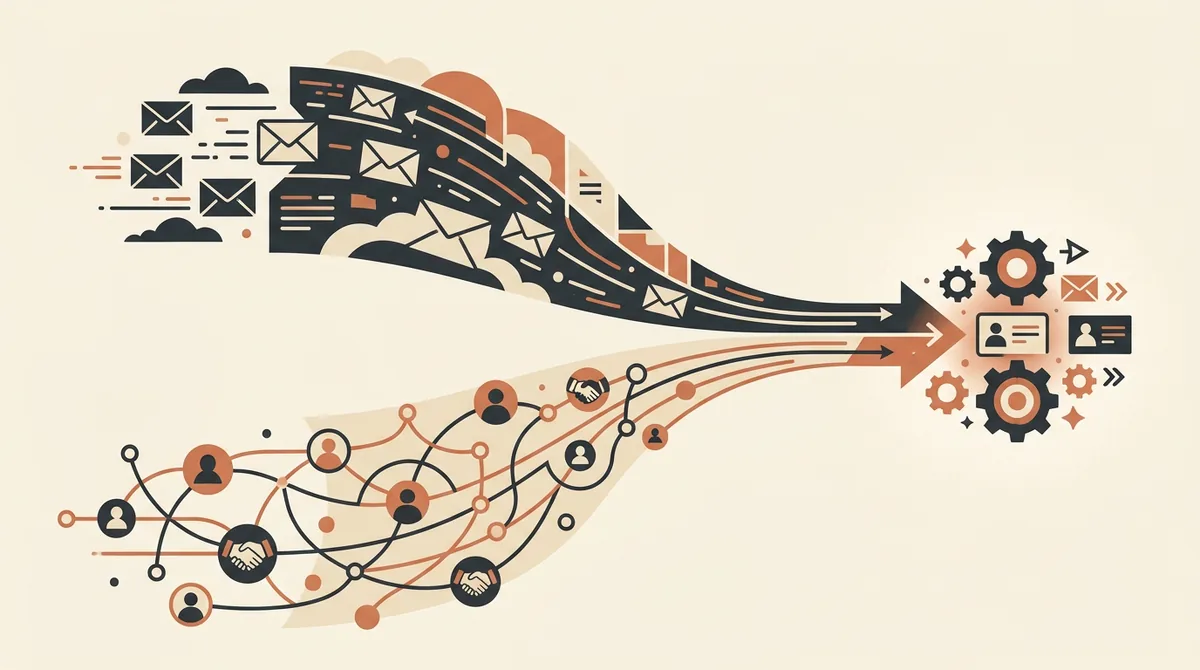
Most articles on this topic hand you a pros-and-cons list and close with "use both." True, but useless without the how. And nearly everyone skips a piece that, in a regulated market, weighs more than reply rates: what the data protection rules actually allow.
Here are the real 2026 numbers, the real limits of each channel, the legal constraint that changes the math, and a multichannel sequence that actually works.
Cold email vs LinkedIn: the two channels in one line
The core difference isn't technical, it's structural. Cold email is a volume channel: you reach many people directly, including the ones who aren't on LinkedIn at all. LinkedIn outreach is a relationship channel: you reach fewer people, but with more context, more trust, and — measurably — a higher response rate per contact.
Boil each one down to its purpose and the confusion disappears:
- Cold email = reach a lot of decision-makers fast, at a low cost per contact, in a way you can measure.
- LinkedIn = build credibility and start conversations with senior profiles who are hard to reach by email.
Everything else — costs, tools, tactics — flows from this. Once the distinction is clear, the choice stops being a matter of taste.
The 2026 numbers: reply rate, volume, cost
Enough opinions, let's look at the benchmarks. The 2026 data tells a clean story: LinkedIn wins on reply rate per contact, cold email wins on volume and cost. Neither one dominates across the board.
| Metric | Cold email | |
|---|---|---|
| Average reply rate | 2-5% | 10-20% (personalized InMails can go higher) |
| Realistic daily volume | 200-500 contacts | ~20-40 contacts |
| Monthly volume | 6,000-10,000 | 400-700 |
| Cost per lead (indicative) | low, scales well | higher per contact |
| Access to senior/C-level profiles | medium | high |
The practical takeaway: cold email gives you numbers, LinkedIn gives you quality of conversation. Cold email's reply rate has been sliding for years. It was above 8% in 2019; today it sits around 3-5% when the infrastructure is solid, and much lower when it isn't. LinkedIn holds higher rates precisely because the professional context lowers people's guard.
There's a detail almost nobody points out: email gets seen more often (15-25% open rate), but on LinkedIn you get replies more often. These are two different bottlenecks. If your problem is getting noticed, that's one conversation; if it's getting a reply, that's another. To see how these numbers fit into the buying journey, think in terms of the lead generation funnel, not a single message.
The real limits of each channel (the ones nobody tells you upfront)
Benchmarks aren't enough. Every channel has a structural ceiling that decides how hard you can actually push.
LinkedIn: the 100-invites-a-week wall
LinkedIn hard-caps you at roughly 100 connection requests per week per account, on a rolling 7-day window. You can't buy your way past it with Premium: the limit depends on account reputation (acceptance rate, account age, SSI), not the subscription tier.
Go over the limit and you get warnings first, then temporary restrictions, then a ban. And in 2026 most of these restrictions are triggered by automation tools, not manual activity: LinkedIn actively scans for extensions and bot-like behavior.
The consequence: LinkedIn doesn't scale the way you'd want it to. You can run more accounts, but that's added complexity and added risk.
Cold email: the deliverability wall
Cold email scales, but only if the infrastructure holds up. Domains and inboxes need warming up, IP reputation needs tending, bounces need managing. Skip these steps and you end up in spam: you send 5,000 emails and only a fraction actually get read.
The "300-500 a day" volume figure only holds with pre-warmed inboxes and inbox placement above 94%. Without that, the number stays theoretical.
Bottom line: both channels have a hidden entry price. On LinkedIn it's account risk; on cold email it's technical infrastructure. Anyone promising you unlimited scale with zero friction is selling you something.

Want to know which channel mix would actually work for your B2B business, without spending months testing it by hand? Let's talk.
The factor that changes everything in the EU: data protection compliance
This is where US-focused guides leave you on your own. In Italy and across the EU, cold email isn't a free-for-all, and Italy's data protection authority (the Garante) has already fined companies over campaigns run without the right requirements in place. This changes the cold email vs LinkedIn math in a concrete way: it raises the compliance cost of the email channel, not just the economic one.
In short, without pretending to give legal advice:
- Generic company addresses (info@, sales@): prior consent generally isn't required, but you do need a clearly identified sender, a documented legal basis (usually legitimate interest, GDPR art. 6.1.f), and a working, immediate opt-out.
- Named personal addresses (firstname.lastname@company): legitimate interest has to be assessed case by case through a balancing test. More delicate ground.
- Fines can reach up to €20 million or 4% of global turnover. This isn't a hypothetical risk.
LinkedIn has a quiet advantage here: you're operating inside a platform where professional contact is the norm, and you're not processing cold email addresses. It doesn't exempt you from data protection law, but it shifts where the risk sits. If your industry is regulated or your brand is exposed, that matters. Compliance, in other words, isn't a detail to hand off to legal at the end of the project — it's a variable in choosing the channel itself.
When to choose cold email
Cold email is the right move when:
- You sell something with a low-to-mid ticket size and a short cycle (SaaS for SMBs, packaged services, agencies): you need volume and predictability.
- You need to test a new market or a new ICP quickly, without first building a presence.
- Your target isn't active on LinkedIn (many traditional industries, manufacturing, operations).
- You already have — or are building — solid deliverability infrastructure and compliance in order.
If your economics depend on the number of open conversations, cold email gives you the most aggressive cost per lead. It's the volume engine of outbound.
When to choose LinkedIn
LinkedIn wins when:
- You sell complex, high-value deals (€30-50K+, 6-12 month cycles) with multiple decision-makers involved.
- Your target is C-level or senior, hard to reach by email but present and active on the platform.
- Your asset is the founder's or team's credibility: content, social selling, relationship before pitch.
- You operate in an industry with aggressive email filters or a brand with significant reputational exposure.
Here you're not buying volume, you're buying trust and access. A single enterprise deal pays back months of low-cadence outreach. It's the channel for relationship quality.
The truth: it's not "either/or"
The B2B teams performing best in 2026 don't choose. They sequence. According to the data, multichannel outreach lifts engagement dramatically compared to any single channel: combining email and LinkedIn typically produces 2-3x more positive replies than email alone, for the same number of contacts.
A 6-touch sequence that works, in order:
- Touch 1, LinkedIn: visit the profile and send a connection request (no pitch). This warms up the contact.
- Touch 2, Email: first direct message, with a real hook (problem plus value, not features).
- Touch 3, Email: value-add follow-up (a case study, a data point, a resource) — not a "just checking if you saw this."
- Touch 4, LinkedIn DM: break inbox fatigue with a short message on the platform.
- Touch 5, Email: final follow-up with a clear, low-friction CTA.
- Touch 6, LinkedIn: soft close or engagement with their content, to stay on their radar.
LinkedIn warms the contact up, email closes, LinkedIn keeps the relationship alive. The question isn't "which channel," it's which channel at which point in the sequence. It's the same logic behind choosing any channel: read up on which customer acquisition strategies actually work and which ones burn budget before you commit resources to a single front.
The real bottleneck isn't the channel: it's execution
Here's the part nobody spells out. In 2026, the cold email vs LinkedIn choice matters less than the quality of multichannel execution. The wall isn't "which channel is better" — it's that running both well, by hand, is an enormous amount of work: clean lists, real personalization, warm-up, cadence, timely follow-ups, compliance.
This is where AI changes the game, if it's used seriously and not as a gimmick. Not AI that writes generic emails, but agents that:
- enrich and qualify lists based on real intent signals;
- personalize every message to the individual prospect's context, not a {firstname} token dropped into a template;
- manage multichannel cadence and follow-ups without missing a beat;
- flag which leads are genuinely ready, so the human team only talks to the ones that matter.
Dig deeper into how this works in our guide to AI-driven lead generation and, specifically, what AI agents for lead generation actually do. It's exactly the model we operate on at AstraLoop: we combine AI and automation with lead generation, and the numbers back it up — 370K+ qualified leads generated, 60+ companies served, and 210% average growth. Not because one channel is magic, but because we run both, well, tailored to the client's funnel.
How to decide, in practice
If you have to start with just one channel, decide this way:
- Short cycle, low ticket, high volume? Cold email (with infrastructure and compliance in order).
- Long cycle, high ticket, senior target? LinkedIn.
- Exposed brand or regulated industry? Start with LinkedIn, then layer in email on a solid legal basis.
- Want maximum results and have the capacity (or a partner)? Multichannel sequence, always.
Cold email vs LinkedIn isn't a war to win: it's an allocation decision to get right, inside a bigger strategy. If you want the full picture on acquiring qualified customers, start with our pillar guide to B2B lead generation. And if you'd rather skip the theory and see how an AI-powered lead generation agency actually works, you know where to find us.
Frequently asked questions
Cold email or LinkedIn: which converts better in B2B?
It depends on the goal. LinkedIn has higher reply rates per contact (10-20% versus 2-5% for cold email), but cold email scales much further in volume and at a lower cost per lead. LinkedIn wins on complex, senior-level deals; cold email wins on volume and short cycles. The best results come from combining both in sequence.
Is cold email legal under EU data protection rules?
Yes, but with constraints. For B2B outreach to generic company addresses, you can generally rely on legitimate interest (GDPR art. 6.1.f), provided you clearly identify the sender, document the legal basis, and offer an immediate opt-out. Named personal addresses require a case-by-case balancing test. Italy's data protection authority has already fined non-compliant campaigns, with penalties up to €20 million or 4% of turnover.
How many contacts a day can I make on LinkedIn without risk?
LinkedIn caps you at roughly 100 connection requests per week per account, on a rolling 7-day window. The limit depends on account reputation, not the subscription tier. Exceeding it or using aggressive automation leads to warnings, temporary restrictions, and, in repeat cases, a ban.
Do I need technical infrastructure to run cold email?
Yes, if you want results. Domains and inboxes need warming up, IP reputation needs tending, and bounces need managing, or you end up in spam. A volume of 300-500 emails a day is only realistic with pre-warmed inboxes and inbox placement above 94%. Without that infrastructure, you send a lot and few people read it.
Is it better to run cold email and LinkedIn together or one at a time?
Together, if you can. The data shows a multichannel sequence typically produces 2-3x more positive replies than a single channel alone. The winning logic: LinkedIn to warm up and connect, email to get straight to the point and close, then LinkedIn again to keep the relationship alive.
If you want to turn cold email and LinkedIn into a single system that generates qualified leads while you focus on everything else, write to us at astraloopstudio@gmail.com: we'll build the right sequence for your funnel.