Brand Tone of Voice: How to Define It (Guide + Template 2026)
8 min read · AstraLoop Studio
Ask ten companies what their tone of voice is and nine will give you the same three adjectives: professional, reliable, innovative. Words that say nothing, that nobody actually uses when writing to a customer, and that you could paste onto a competitor's site without anyone noticing.
A company's tone of voice isn't invented in a meeting. It's extracted. It's already sitting inside your reviews, in your sales call transcripts, in support chats, and in the way customers describe your product when they talk about it to each other. This guide walks you through a practical 5-step framework for pulling it out of data you already have and turning it into a document your team actually uses, with a ready-to-copy template included.

What corporate tone of voice actually means
One distinction clears up most of the confusion. Brand voice is the constant personality behind how you communicate: it never changes, the same way a person's character doesn't change. Tone is how that personality adapts to context. The same person speaks differently at a funeral than at a party, while still being themselves.
A concrete example: a brand with a "direct and friendly" voice keeps that voice both when replying to an angry customer ("You're right, we dropped the ball, here's how we're fixing it") and when launching a promo ("New arrivals, and this time we went a little overboard"). The tone shifts. The identity doesn't.
In everyday usage (and in search behavior), "brand tone of voice" refers to the whole system: voice plus tone. We'll use it that way here. What tone of voice is not:
- It's not a list of adjectives. "Professional" describes how you want to come across — it doesn't tell you how to write your next sentence.
- It's not copying a brand you admire. The tone of a sneaker e-commerce store doesn't work on an accounting firm.
- It's not a decision handed down by the founder in ten minutes. It's a pattern that already exists in your conversations.
Why extracting it from data beats a whiteboard exercise
When you define tone in a meeting room, you describe the brand as you'd like it to be. Customers, on the other hand, describe it as it actually is. There's a gap in between, and every word you write that drifts from how your customer actually talks creates friction: it slows down reading, lowers trust, and cuts conversions.
Example: if your customer writes "finally, someone who actually responds," and you communicate with "we offer multichannel support services," you're throwing away the phrase that sells (actually responds) for one that says nothing. Data gives you three things at once: the real vocabulary (words that already resonate), the recurring objections to defuse in your copy, and the perceived benefits in the exact words of the people buying.
Defining tone isn't a style exercise — it's the foundation of every piece of copy you publish. For the full picture, start with our pillar guide on copywriting for customer acquisition; here we're zooming in on one specific piece: how to pull tone out of data.
The 5-step framework for defining tone of voice
Five steps, from raw collection to an operational document. The end output is two things: a short document and a shared vocabulary. You can get through both in one or two weeks of part-time work.
Step 1. Gather the right sources
The raw material is "voice of customer": everything your customers have already written or said. The best sources, in order of richness:
- Reviews, both yours and competitors' (Google, Trustpilot, industry marketplaces).
- Call transcripts from sales and support: this is where customers speak freely.
- Chats and tickets from customer care, where everyday doubts and everyday words surface.
- Comments and DMs on social, reply emails, post-purchase surveys.
How much material do you need? A solid starting point is 50-100 reviews and 10-20 transcripts. Reviews are the richest vein: if you don't have a steady flow of them, fix that first (see our guide on how to build a customer review strategy).
Step 2. Extract the language patterns
Now read through everything with one goal: finding recurring patterns, not impressions. For each source, note down:
- The exact words and phrases that come up most often (register, jargon, metaphors).
- How customers describe the problem before buying and the result after.
- Emotional words (fear, relief, pride, frustration) and objections.
- The level of formality: do they address you informally or formally? Do they use emoji, abbreviations, exclamation points?
A spreadsheet with three columns (quote, theme, emotion) is enough. You can speed this up with AI by asking it to cluster hundreds of sentences by recurring theme, but reading at least a portion by hand gives you a feel that no automatic clustering can replace.
Step 3. Position the brand across 4 dimensions
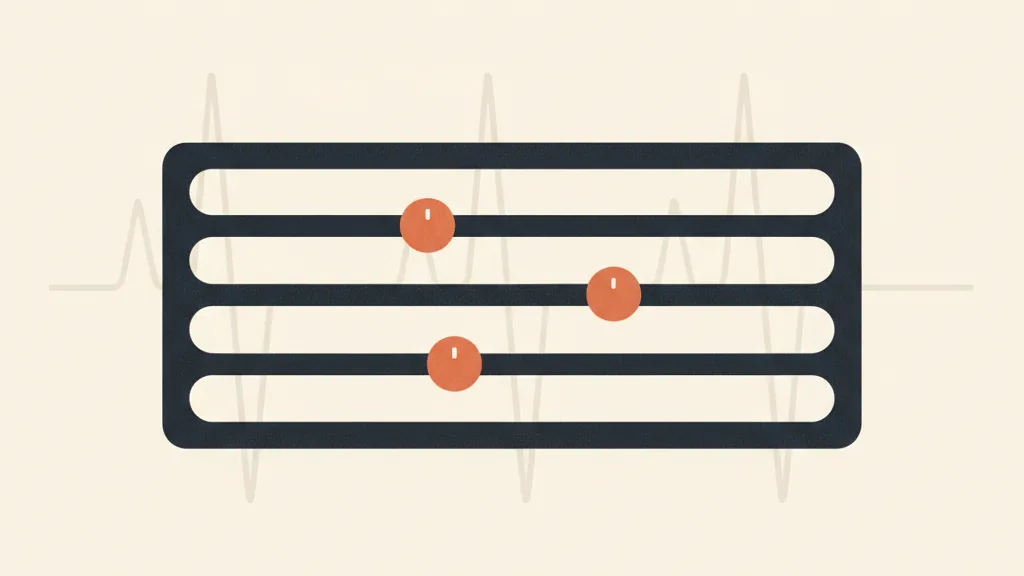
Now the patterns turn into choices. The Nielsen Norman Group, one of the most cited authorities in UX, describes tone along four dimensions. For each one, decide where you sit — and, more importantly, justify it with the data you collected.
| Dimension | Extremes | How to read it in the data |
|---|---|---|
| Register | Formal vs. Casual | If customers address you informally and use abbreviations, casual is already validated. |
| Humor | Serious vs. Funny | Is there irony in the positive reviews, or are customers looking for reassurance and expertise? |
| Respect | Formal/institutional vs. Irreverent | Does your audience reward those who break the mold, or those who reassure with authority? |
| Energy | Matter-of-fact vs. Enthusiastic | Do high-energy words land, or does your customer want data and concreteness? |
There's no universally right position: there's only the one that's consistent with the people buying from you. A law firm sits toward formal, serious, institutional, matter-of-fact. A supplement brand for under-30s can sit at the opposite end on all four. There's only one rule: the position comes from the data in Step 2, not from the preferences of whoever's leading the meeting.
Want your tone of voice turned into copy that actually acquires customers — consistent across email, ads, and AI assistants? Tell us about your situation and we'll tell you where to start.
Step 4. Codify it in a document (the template)
A tone that lives only in the head of whoever defined it is useless. It needs to be written down in a short, operational document (2-4 pages, not a manual). Here's the template structure:
- The voice in one sentence. "We're the knowledgeable friend who tells it like it is, without dancing around it."
- 3-5 traits with an operational definition: for each, what to do and what to avoid.
- Position on the 4 dimensions from Step 3, with a one-line rationale.
- Vocabulary: words we use and words we ban. Keep a list of high-impact power words that fit the voice, plus a blacklist of terms to avoid.
- Style rules: formal or informal address, emoji yes or no, average sentence length, how numbers are written (in Italian it's written 39,99 not 39.99 — check the equivalent convention for your market), formatting.
- Side-by-side examples, "we say this / not this," for the key contexts.
Side-by-side examples are the part the team uses the most. Make them concrete:
| Context | We say this | Not this |
|---|---|---|
| Unhappy customer | "You're right, we'll fix this right away." | "Your complaint has been taken in charge by the relevant department." |
| Email opener | "Hi Marco, quick one for you." | "Dear Customer, we are writing to inform you that..." |
| Price | "39.99, delivered in 48 hours." | "Only 39.99!! Unmissable offer!!!" |
The document stays valid even when the structure of the copy changes: apply a framework like AIDA, PAS, or BAB and the tone doesn't move — only the persuasive architecture does.
Step 5. Make the tone operational and alive
A document buried in a forgotten folder is dead weight. To keep it alive:
- Distribution: build it into the onboarding of everyone who writes (marketing, sales, customer care), and turn it into a review checklist to use before publishing.
- Scale it with AI: the fastest way to keep consistency at high volume is to train an AI model on your brand voice, using the document and examples as reference, so every draft is born already in tone.
- Keep it updated: revisit the document every 6-12 months, or whenever your audience, product, or positioning shifts. Tone evolves with the data — repeat Step 1 on a fresh sample.
The mistakes that turn tone of voice into dead paper
- Stopping at three adjectives. Without "say this / not this" examples, no one will know how to apply them.
- Copying a brand from a different industry. The right tone is the one your audience responds to, not the one you personally admire.
- Defining it without the people who actually write. Whoever's on the phone or in chat knows the real vocabulary better than anyone in a slide deck.
- Writing 40 pages. A long document doesn't get read. Keep it to 2-4 pages, dense with examples.
- Never updating it. Your audience changes, and so does your tone.
How to keep tone consistent across channels, teams, and AI
The voice stays the same everywhere; the tone adapts to the channel and to the reader's emotional state (a LinkedIn post, a support reply, and an ad don't run at the same temperature). Consistency breaks down as headcount and volume grow, especially once copy starts coming from AI-automated processes. The fix isn't checking every sentence by hand — it's feeding the document in upstream: an AI copywriting assistant aligned to your tone of voice produces drafts that are already on-brand, leaving human review to handle only the final polish. That's how tone stops being a slide and becomes an asset that works across every channel.
Frequently asked questions
What's the difference between brand voice and tone of voice?
Brand voice is the constant personality behind how you communicate, and it never changes. Tone of voice is how that voice adapts to context: the same identity sounds different in a welcome email than in a reply to a complaint.
How much data do you need to define tone of voice from real customer language?
A solid starting point is 50-100 reviews plus 10-20 call or chat transcripts. You don't need statistical perfection — just enough sources for recurring patterns in customer language to surface.
How long should a tone of voice document be?
2 to 4 pages. It needs to be operational, not a manual: one sentence summarizing the voice, 3-5 traits, the position on the dimensions, the vocabulary, and above all side-by-side "say this / not this" examples.
How often should you update your brand's tone of voice?
Revisit it every 6-12 months, or any time your audience, product, or positioning changes. Repeat the data-collection step on a fresh sample to see whether your customers' language has shifted.
Can AI be used to write in your brand's tone of voice?
Yes. By instructing or training a model with the document and a set of real examples, AI can produce drafts already aligned to your voice. Human review is still necessary, especially for sensitive content.
Does tone of voice change depending on the channel?
The voice doesn't, the tone does. On LinkedIn, in an ad, and in a support reply, the same identity shifts register and energy while still being recognizable as the same brand.
If you want your voice to live inside your emails, funnels, and AI agents without checking every sentence by hand, let's talk: we'll analyze your data and build the system.