AI Phone System Pricing: What the Monthly Fee Really Includes
10 min read · AstraLoop Studio
When you search for the price of an AI phone system, you almost always hit the same wall: no clear price list. You find "starting from €99 a month" or "contact us for a quote," and you're left wondering whether you're about to pay a fair price or get sold thin air. The truth is an AI phone system isn't a single product. It's the sum of several cost items that combine differently depending on what you actually need.
In this article we break the monthly fee down piece by piece: initial setup, conversation minutes, integrations with your management software, maintenance. We'll show you the real ranges seen on the Italian market in 2026 and, above all, which factors drive the bill up (sometimes for good reason, sometimes not). The goal is for you to walk into any quote already knowing exactly what you're reading.

The 4 items that make up an AI phone system's monthly fee
Before we look at numbers, let's set things straight. Any serious quote, however much it hides behind a single "all-inclusive fee," rests on four cost pillars. If a provider can't explain them separately, that's already a red flag.
- Setup (one-off): the initial configuration. Phone number, training the assistant on your services, conversation scripts, voice, testing.
- Platform fee (recurring): the fixed monthly cost to keep the system running, updated and online.
- Conversation minutes (usage-based): how much each minute the AI actually spends talking to someone costs.
- Integrations and maintenance (variable): connections to CRM, calendar, booking software, plus ongoing updates.
The total you'll pay depends on how these four elements weigh in your specific case. A restaurant that just wants 24/7 booking has a very different cost profile from a medical practice that needs to read and write to the calendar in real time. Let's go through them one by one.
1. Setup: what it costs to get the system running
Setup is the most misunderstood part. Some providers zero it out to reel you in, others load it up with thousands of euros. The truth sits in the middle and depends on how "custom" your assistant needs to be.
| Setup type | Typical range | What it includes |
|---|---|---|
| Self-service / template | €0 - 300 | Preconfigured assistant, a handful of FAQs, standard voice |
| Custom-configured | €500 - 2,000 | Custom scripts, training on your services, thorough testing |
| Complex project | €2,000 - 6,000+ | Multiple flows, deep integrations, industry-specific tuning |
What legitimately drives setup costs up? The number of cases the assistant needs to handle. A voicebot that only answers "we're open from 9am to 7pm" is nearly free to configure. One that has to figure out whether the caller wants to book, cancel, ask for a quote, request a callback, or speak to a human requires flow design that takes time. The more articulated your services, the heavier the setup.
Watch out for one trap: a zero-euro setup often means a rigid assistant that answers poorly the moment a conversation strays off script, causing you to lose exactly the calls you wanted to save. If you want to dig into how the training phase actually works, we've dedicated a guide to how an AI phone system works under the hood.
2. Platform fee: the fixed monthly cost
This is the recurring fee you pay to keep the service running, regardless of how many calls you get. It covers infrastructure, voice model updates, monitoring and (with serious providers) support.
On the Italian market in 2026, platform fees for a single-location SMB typically fall into these tiers:
- Basic tier: €49 - 120/month. A single assistant, one number, essential features.
- Professional tier: €150 - 400/month. Multiple numbers or locations, integrations included, reporting, premium voice.
- Business tier: €400 - 1,000+/month. Multi-location, guaranteed SLAs, dedicated account management.
The fee is the most predictable item, which is exactly why you need to check what's really included. The right question to ask a provider is: "How many minutes are included in this fee? Are integrations bundled in or billed separately? Is support included or ticket-based?" If the answer is vague, today's low fee becomes tomorrow's painful bill. For a full picture of pricing, our deep dive on how much an AI voice assistant costs is also worth a read.
3. Conversation minutes: the line item that slips through the quote
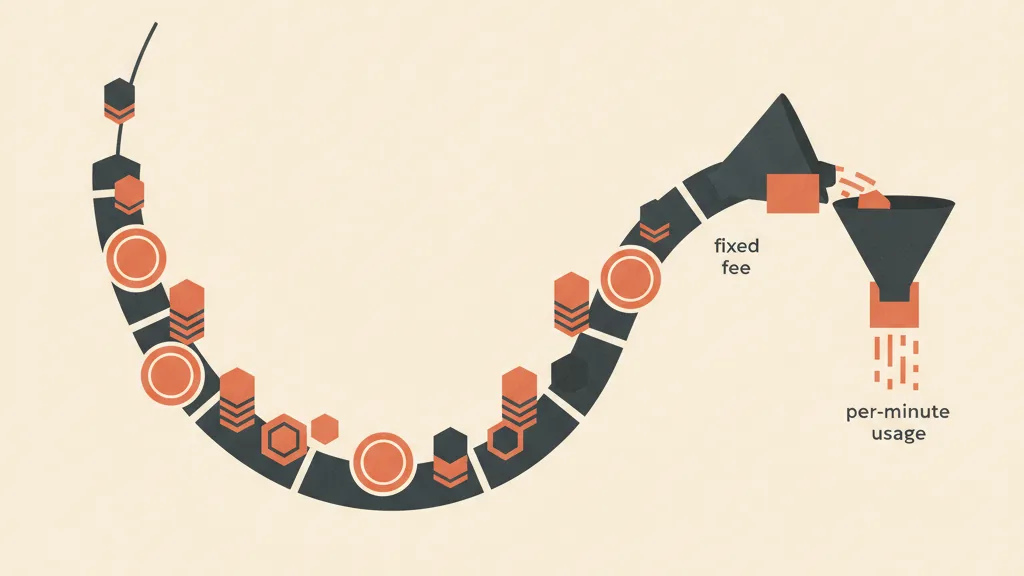
This is where the most common surprise hides. Many people compare only the fee and ignore the usage-based cost, which during peak periods can weigh as much as, or more than, the fixed portion.
The cost per minute of AI conversation in Italian in 2026 ranges, depending on provider and technology, between €0.08 and €0.25 per minute. The difference comes down to the quality of the voice engine. Next-generation speech-to-speech technology (native audio-to-audio, latency under 320 milliseconds, natural handling of interruptions) costs more than the old "transcribe, process, synthesize" chain, but the conversation feels far more natural and closes more calls without frustrating the customer.
Let's run concrete numbers. Imagine a local business that gets 400 calls a month, averaging 2 minutes each:
- 800 minutes a month
- At €0.12/minute, that's €96/month in usage
- At €0.20/minute, that's €160/month in usage
This adds on top of the fee. That's why "€99 a month" without specifying included minutes tells you almost nothing. Always ask how many minutes are in the package and what the overage rate is per minute. Usage-based cost, though, should always be weighed against the flip side of the coin: what every missed call actually costs you. For many local businesses, a single appointment that never got booked is worth more than an entire month of minutes.
4. Integrations and maintenance: where the price really climbs
This is the most variable item, and the one that separates a toy from a tool that actually saves you hours. An AI phone system that answers calls but doesn't "talk" to your systems is only half the job. The real value shows up when the assistant writes the appointment to the calendar, updates the customer record in the CRM, and sends the reminder via WhatsApp.
Integrations split into two worlds:
- Standard integrations (Google Calendar, common management software, popular CRMs): often included in the fee, or with a small surcharge of €20 - 80/month.
- Custom integrations (your proprietary management system, industry-specific software, particular workflows): here you're looking at anywhere from a few hundred to several thousand euros one-off, plus maintenance.
Maintenance is the silent cost almost nobody puts in the quote. A voice assistant isn't "install and forget": it needs updating whenever you change services, prices, or hours; it needs fixing when it gets an answer wrong; it needs retraining when a better voice engine comes out. A serious provider includes a minimum of maintenance in the fee. If they bill you by the hour every single time, factor that in. If you want to go deeper on the technical side, read how to integrate an AI voice assistant with your CRM.
What drives the price up (and when it's worth it)
Let's sum up the factors that inflate the fee, separating the justified ones from the ones that are just markup.
| Factor | Effect on price | Worth it? |
|---|---|---|
| Natural speech-to-speech voice | High | Yes, it reduces abandoned calls |
| Number of flows/cases handled | High | Only the ones you actually use |
| Integration with custom management software | High (one-off) | Yes, if it saves you hours of work |
| Multilingual support | Medium | Only if you have foreign customers |
| Handoff to a human operator | Medium | Yes, it's a safety net |
| Multi-location / multiple numbers | Medium-high | If you have multiple locations |
| Advanced reporting and analytics | Low-medium | Useful but not a priority at first |
There's one factor you should always insist on, even if it costs extra: handoff to a human operator when the AI doesn't know how to respond. A phone system that leaves the customer at a dead end does more harm than good. Configuring it properly costs a bit more, but it's what separates a reliable system from one that loses you your most important customers.
Want a quote for an AI phone system broken down line by line, with no surprises at the end of the month? Request a free analysis and we'll help you figure out what you actually need.
Compliance: a hidden cost that's about to become mandatory
There's one line item that's no longer optional in 2026, and it needs to go into the budget from day one. As of August 2, 2026, the obligations of the AI Act (EU Regulation 2024/1689) come into full effect for AI systems that interact with people. In Italy, Law 132/2025 adds to this, reinforcing the transparency principle: whoever calls must be informed they're speaking with an AI system, not a person.
What does this mean in practice for your AI phone system? The assistant must clearly declare its nature at the start of the conversation. This isn't just good manners, it's a regulatory requirement. A provider that hasn't planned for this is selling you a system that could put you out of compliance. Check that the automatic disclosure is included and configured, and ask how call recording is handled with respect to GDPR.
This isn't a substitute for legal advice, but the point is simple: compliance isn't an extra cost to negotiate, it's a baseline feature of any good AI phone system in 2026. We go deeper on this in our article on the obligation to disclose AI on phone calls and in the broader overview of AI Act obligations for SMBs. If a quote never mentions the word "transparency," ask yourself some questions.
How to read a quote without getting ripped off
Let's put it all together in a practical checklist. When you receive an offer for an AI phone system, ask that it be broken down like this:
- One-off setup: how much it costs and what it includes (scripts, training, testing).
- Monthly fee: what's included and what isn't.
- Included minutes and overage cost: the figure that makes the real difference to the total.
- Integrations: which are included, which cost extra, and how much.
- Maintenance and support: included in the fee or billed by ticket.
- AI Act / Law 132/2025 compliance: automatic disclosure in place.
- Human handoff: what happens when the AI doesn't know how to respond.
A quote that answers these seven points lets you compare apples to apples. One that hides behind an "all-inclusive" label without details doesn't. The right price isn't the lowest one: it's the one that covers every item with no surprises at the end of the month.
To figure out whether an AI phone system fits your cost structure, it's worth comparing it with the classic alternative. We put the two options head to head in our article AI receptionist vs. human secretary, where the numbers speak for themselves for many local businesses. And if you want the big picture, start with our complete guide to AI phone systems.
What you should expect to spend, in short
To give you a ballpark to keep in mind for an Italian SMB or local business in 2026, without exotic custom integrations:
- Simple local business (restaurant, beauty salon, gym): setup €300 - 1,000, fee €80 - 200/month, minutes €50 - 150/month. Estimated recurring total: €130 - 350/month.
- Professional practice or medical clinic (with calendar integration): setup €1,000 - 3,000, fee €200 - 450/month, minutes €80 - 250/month. Estimated recurring total: €280 - 700/month.
These are ranges, not absolute truths: they're there to help you spot a quote that's out of scale, too high or too low. An offer well below these figures usually cuts corners on voice quality or maintenance. One well above needs to justify itself with real integrations or volumes. If you're staring at numbers that don't add up and want an outside opinion, we're here to help you make sense of them.
Frequently asked questions
How much does an AI phone system cost on average per month?
For an Italian SMB or local business, the recurring cost typically falls between €130 and €700 a month, combining the platform fee and conversation minutes. The range depends on integrations and call volumes. On top of that comes a one-off setup fee ranging from a few hundred to a few thousand euros.
Are minute costs included in the monthly fee?
It depends on the provider. Many include a bundle of minutes in the fee and bill anything beyond that separately, at €0.08 to €0.25 per minute. It's the most underestimated line item: always ask how many minutes are included and what the overage rate is, because during peak periods it can weigh as much as the fixed fee.
Why do some AI phone systems cost much more than others?
The main differences are voice quality (natural speech-to-speech engines cost more than the old, robotic ones), the number of flows the assistant can handle, integrations with your management software, and the level of maintenance included. A very low price usually cuts corners on one of these.
Is the initial setup always a paid item?
No. Some providers offer zero-cost setup with preconfigured, template-based assistants, but these are often rigid and poorly personalized. A custom setup, with scripts and training on your specific services, costs between €500 and €2,000 and usually pays for itself in saved calls and less customer frustration.
Do I have to pay more to comply with the 2026 AI Act?
Compliance shouldn't be an extra cost to negotiate, it should be a baseline feature. As of August 2, 2026, the AI Act (EU Regulation 2024/1689) and, in Italy, Law 132/2025 require that callers know they're speaking with an AI. A good provider already includes automatic disclosure and proper data handling under GDPR.
What happens when the AI assistant doesn't know how to respond?
In a well-configured system, human handoff kicks in: the call gets transferred to a human operator, or a callback request is collected. It's a feature that can add a small cost, but it's worth insisting on: a phone system that leaves the customer without an answer costs you exactly the calls that matter most.
If you've got a quote in hand and the numbers don't add up, talk to us: we'll give you an honest opinion on what's fair to pay and what's just smoke.