Account-Based Marketing (ABM): What It Is and How to Apply It
8 min read · AstraLoop Studio
Most B2B strategies start with a wide funnel. You run ads and content, collect as many contacts as possible at the top, and hope some of them turn into customers at the bottom. Account-Based Marketing (ABM) flips that model. You don't start from contacts, you start from companies. You decide which 50, 100, or 300 businesses you want as customers and pour all your marketing and sales energy into them, treating every single account as if it were a market of its own.
In a market like Italy's, made up of SMEs, narrow verticals, and slow buying cycles, this approach often makes more sense than mass cold outreach. But it's also easy to misunderstand and easy to execute badly. In this article we look at what ABM really is, when it's worth doing, how to structure it, and where Italian agencies get it wrong.
Account-based marketing: the definition in one line
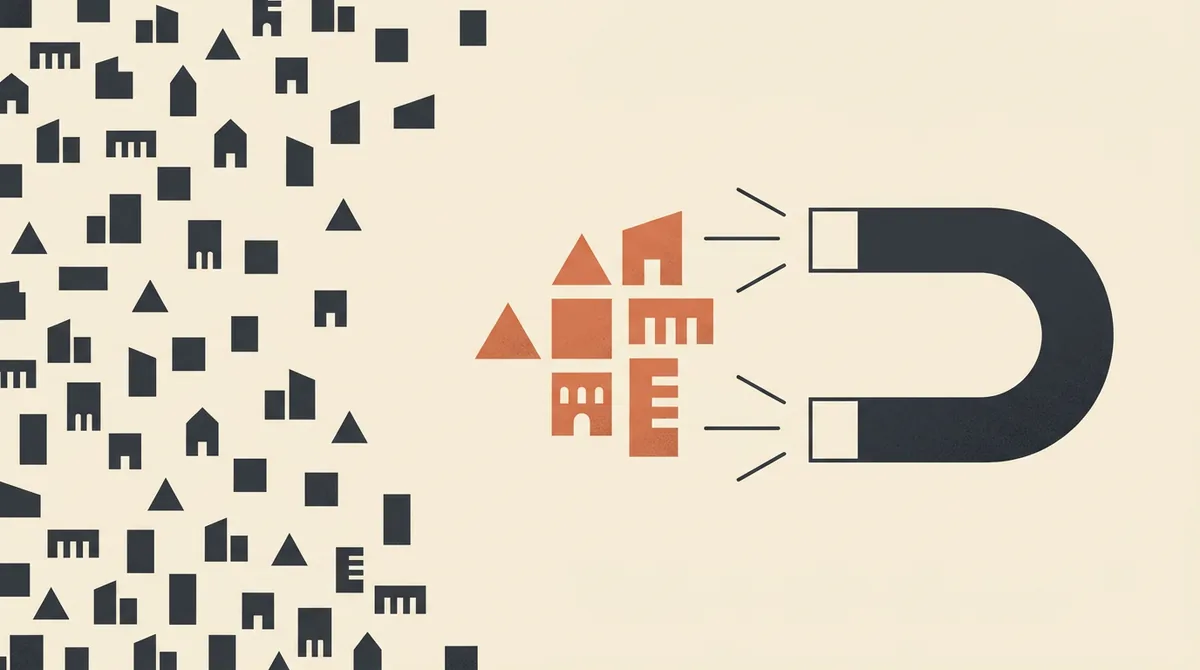
Account-Based Marketing is a B2B strategy where marketing and sales treat a small, hand-picked set of target companies (the "accounts") as individual markets, tailoring messages, content, and channels to each one. In practice, instead of asking "how many leads can I generate?", the question becomes "how do I get these specific companies into my portfolio?"
The key difference from classic lead generation is direction. Traditional lead generation works from the general to the specific: attract many, qualify, filter down. ABM works the other way around, from the specific to the general: it picks the company names first and then builds the conversation around them. That's why people often say ABM flips the funnel.
Hyper-personalized digital ABM
In its modern, digital version (the one we're discussing here), ABM combines hand-built account lists, enriched company data, and personalized messages distributed across multiple channels: email, LinkedIn, targeted ads, custom content. It's not one more email with the company name pasted in. It's a system where every account gets a journey designed around its industry, its size, its specific problem.
The three intensities of ABM
Not all ABM has the same level of personalization. There are usually three tiers, and choosing one is the first serious strategic decision.
| Type | Number of accounts | Personalization | When it makes sense |
|---|---|---|---|
| One-to-one | 5-30 | Maximum: content and offers built for each single account | Large deals, multi-year contracts, enterprise |
| One-to-few | 30-150 | Medium: clusters by industry or shared problem | Homogeneous verticals, mid-market |
| One-to-many (programmatic) | 150-1000+ | Low but scalable: automation driven by signals | Many similar accounts, average deal size |
Most Italian SMEs approaching ABM for the first time should start with one-to-few: personalized enough to stand out, scalable enough not to burn all the sales team's time on three companies. The classic mistake is promising one-to-one personalization on a list of 400 accounts, something no small team can sustain.
How to build an ABM campaign: the 5 steps
1. Define the ICP and build the account list
Everything starts with the Ideal Customer Profile (ICP): the profile of the company that buys well, stays long, and has high value. Industry, revenue, headcount, geography, technologies used, stage in the company's lifecycle. From there you build the target list: real company names, not abstract categories. An ABM list is a roster of actual businesses, not a Facebook audience.
For an Italian SME, a well-built list is usually 80-250 accounts. With fewer than 50 you don't have enough volume to learn from; with more than 400 you're already sliding into mass cold outreach disguised as ABM.
2. Enrich and map contacts (the buying committee)
In B2B, the company doesn't buy in the abstract: 3 to 7 different people inside it do (the buying committee). For every account you need to identify the key roles: who decides, who uses, who pays, who can block the deal. A message to the IT manager is different from one to the CFO, even at the same company. It's the work of contact qualification applied to the whole account.
3. Personalize messages and content
This is where you win or lose. ABM personalization isn't a {{name}} field in an email. It's knowing the specific problem of that industry, citing a real fact about that company (a new office, a new hire, a regulatory change that affects them), offering a case study from a direct competitor of theirs. Every account cluster has its own angle. Solid structured sales follow-up keeps the conversation alive without becoming intrusive.
4. Activate the channels (multi-channel)
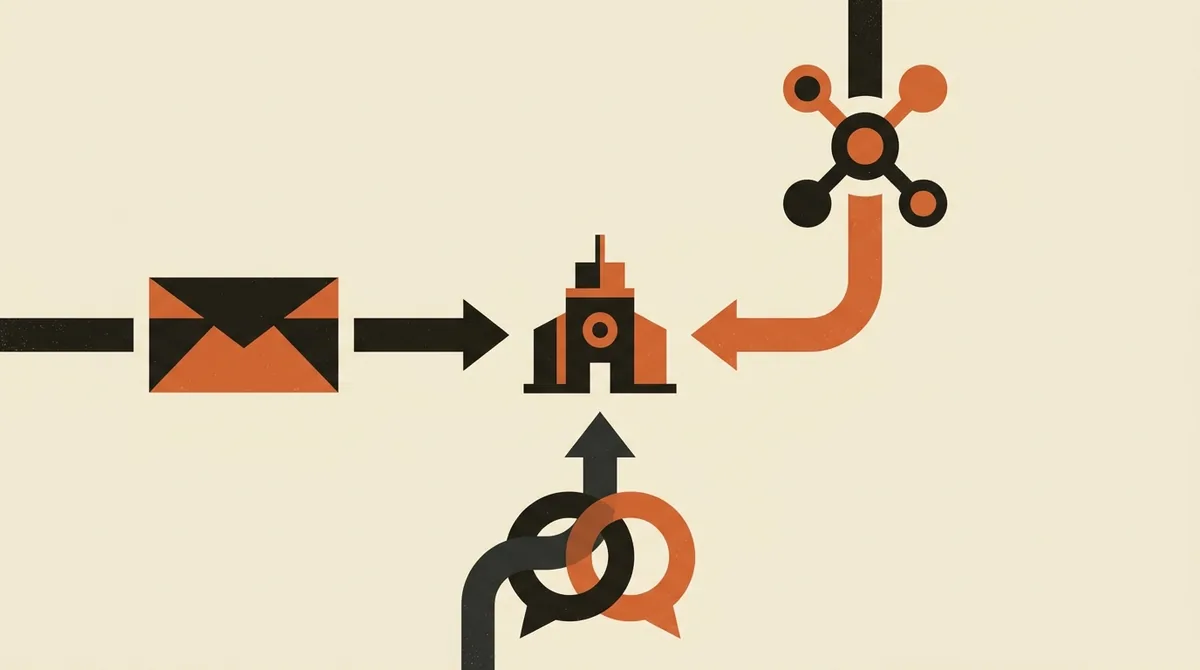
Effective ABM touches the account on multiple fronts during the same period, so your name becomes familiar even before the sale:
- Personalized email: the backbone of outreach, provided deliverability is in order (more on that shortly).
- LinkedIn: connections, content seen by decision-makers, messages. LinkedIn social selling is almost mandatory for Italian ABM.
- Targeted ads: LinkedIn Ads or Meta Ads campaigns that show your brand only to companies on the list, to warm up the ground.
- Custom content: landing pages built for a specific industry, PDFs with data on their sector.
The combination of email and LinkedIn is the backbone of most mid-sized ABM programs.
5. Measure by account, not by lead
ABM metrics are different. You don't count how many leads you generated, but how many target accounts you've penetrated: how many opened a conversation, how many have multiple contacts engaged, how many entered a deal. What counts is account engagement, pipeline covered, and time to close — not the raw number of contacts.
Signal-based: the smart version of ABM
The most modern version of ABM doesn't contact all accounts cold at once, but activates them when they show a buying signal. An executive changing roles, a funding round, a new office opening, repeated visits to your website, a new hire that reveals a priority. Reaching out to an account exactly when something is moving gets far higher response rates than cold outreach on a fixed schedule.
This is called signal-based (or intent-based) selling, still rarely practiced in Italy and often only discussed in English-language content. In practice, the ABM list tells you who, the signals tell you when. Combine the two and you stop shooting in the dark.
Want to figure out which target companies are actually worth pursuing, and how to reach them without landing in spam? Request a free analysis of your acquisition strategy: let's talk it through together.
Italy's Achilles' heel: deliverability
You can have the perfect list and the best messages, but if your emails land in spam, you've wasted everything. This is the point Italian agencies treat with the most carelessness, and by 2026 it has become a genuinely technical matter. Google, Yahoo, and Microsoft have made strict rules mandatory for anyone sending in volume: full authentication, spam rate under 0.3%, bounce rate under 2%, one-click unsubscribe.
Concretely, before launching any ABM email campaign you need to have in place:
- Domain warmup: gradually warming up a dedicated sending domain (never the company's main domain) for weeks before reaching full volume.
- Authentication: SPF, DKIM, and DMARC configured correctly, ideally with DMARC set to
p=reject. - List hygiene: email verification to keep bounce rates low.
If you skip these steps, the reason emails end up in spam won't be the message, it'll be the infrastructure. ABM is high-value per contact precisely because volume is low: a list of 150 accounts won't forgive reputation mistakes the way a send to 50,000 addresses might.
When ABM makes sense (and when it doesn't)
ABM isn't for everyone. It makes sense when:
- Your average deal size is high (contracts worth thousands of euros a year), because personalization costs money and needs to pay off.
- You have a definable, finite market: you can actually list the companies that might buy.
- The buying cycle is long and involves multiple decision-makers.
It doesn't make sense if you sell low-ticket products at high volume, if your audience is huge and undefined, or if you haven't yet nailed down who your ideal customer is. In those cases it's better to start with broader B2B lead generation and refine later. If you want to run the numbers before deciding, take a look at acquisition KPIs and unit economics as well.
ABM as part of a system, not a standalone tactic
The most expensive mistake is treating ABM as a standalone campaign, disconnected from everything else. An account list, without a reliable outreach engine downstream, without qualifying the responses, and without a process that carries the conversation from the first email to the meeting, produces very little. ABM pays off when it's one piece of a complete customer acquisition system: the list defines who to contact, the infrastructure ensures the messages actually land, multi-channel follow-up warms up the account, and a qualification process turns interest into real appointments.
Seen this way, ABM isn't just another marketing trick: it's how you decide which companies to feed into your acquisition system, instead of leaving it to chance. If you want to understand how an owned system differs from buying leads on a pay-as-you-go basis, it's worth exploring the difference between a system and lead generation.
In short
Account-Based Marketing flips the logic of the funnel: you pick the companies you want first, then build a personalized, multi-channel journey around each one. It works when the value per customer is high and the market is definable, and it only truly pays off when it rests on solid deliverability, buying signals, and an acquisition system that carries the conversation all the way to the appointment. Done well, it's one of the most predictable ways to fill a B2B pipeline in Italy. Done badly, it's mass cold email with a fancier name.
Frequently asked questions
What's the difference between ABM and lead generation?
Lead generation attracts many contacts and then filters them down, from general to specific. ABM does the opposite: it picks specific target companies first and builds tailored messages for each one. ABM starts from company names, lead generation from a broad audience.
How many companies should an ABM campaign target?
It depends on the intensity. One-to-one: 5-30 accounts with maximum personalization. One-to-few: 30-150, the ideal starting point in Italy. One-to-many programmatic: 150-1000+ with more automation. Below 50 you don't have enough volume to learn from; above 400 you risk sliding into a mass cold blast.
Is ABM a good fit for Italian SMEs?
Yes, especially in the one-to-few format, when the average deal size is high, the market is definable (you can list your target companies), and the buying cycle involves multiple decision-makers. It's not worth it for low-ticket, high-volume sales or huge, undefined audiences.
What role does email play in ABM?
It's the backbone of outreach, but only if deliverability is in order: a warmed-up domain, SPF/DKIM/DMARC configured (ideally DMARC set to p=reject), spam rate under 0.3%, and bounce rate under 2%. Without these fundamentals, messages land in spam regardless of how good the copy is.
What is signal-based selling in ABM?
It's the more advanced version: instead of contacting all accounts cold on a fixed schedule, you activate them when they show a buying signal (a decision-maker changing roles, new funding, a new office, repeated visits to your site). The list tells you who to contact, the signals tell you when to do it.
How do you measure the results of an ABM campaign?
Not by number of leads, but by account: how many target accounts opened a conversation, how many have multiple contacts engaged, how many entered a deal. The key metrics are account engagement, pipeline covered, and time to close.
If you want to turn ABM into a system that delivers real appointments, not just theory, let's talk: we'll build your B2B acquisition engine together.