Writing for the Web in 2026: SEO and AI Overview Guidelines
7 min read · AstraLoop Studio
Writing for the web didn't end with AI Overviews. The job changed. Until recently there was only one goal: get the page to the top of Google. Today you have two. The copy still has to get indexed and earn the click, but it also has to make sense to a second reader — the model that summarizes the answer before the user even scrolls through the results.
The good news is the two aren't in conflict. Content written well for a reader in a hurry is also the easiest content for an LLM to extract and cite. In this guide we'll look at how to get both: structure, readability, intent alignment, and the practical rules for showing up in Google's AI Overviews and getting cited by ChatGPT, Perplexity, and Gemini — not just ranking tenth.
What actually changed (and what didn't)
In 2026 the results page is no longer a list of ten blue links. At the top you'll often find a generated answer: Google's AI Overviews, the conversational AI Mode, and, increasingly, the answer arrives entirely outside Google, inside an assistant like ChatGPT or Perplexity. The result is that a share of searches close without a click (so-called zero-click).
What hasn't changed: Google still rewards useful content, written for people, backed by real experience. The E-E-A-T principles (experience, expertise, authoritativeness, trustworthiness) don't just still hold — they matter more, because a model that has to pick a source to cite needs clear signals of credibility.
The real shift is this: ranking is no longer enough — you have to become the source that gets summarized. And to be that, the copy needs to be written in a way a machine can read without misreading it.
Your copy has two readers
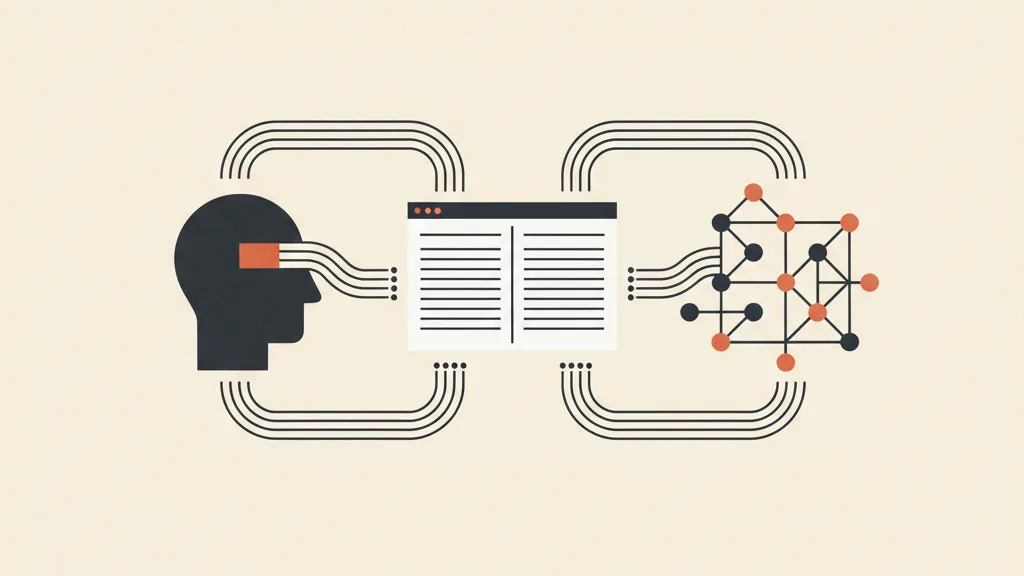
Every page today has two readers with surprisingly similar habits.
The human who scans. Nobody reads a web page word for word. The eye jumps between headings, bold text, and lists, deciding in two or three seconds whether to stay. If it doesn't find a foothold right away, it closes the tab.
The machine that extracts. An LLM doesn't "read" the page like a novel. It breaks it into chunks, scores each one's relevance to the question, and pulls out the clearest, most self-contained ones to use in the answer. A paragraph that only makes sense if you've read the three before it is unusable to the machine.
Hence the rule that holds everything together: write blocks that stand on their own. Each section answers one precise question, each paragraph says one thing and says it in full. That way you help the person who's skimming and the machine that's extracting, in the same move.
Start from intent, not from the keyword
The keyword tells you what words the person uses. Intent tells you what they actually want to achieve. These are two different things, and in 2026 intent wins, because both Google and LLMs evaluate whether the content solves the need, not whether it contains the exact phrase.
Before you write, look at the SERP for your query and ask: does the person searching this want to understand, compare, or buy? The format you need changes accordingly (a guide, a comparison table, an operational cheat sheet). Thinking in terms of the reader's levels of awareness saves you from the most common mistake: answering a question the reader hasn't asked yet, or explaining the basics to someone who's already ready to decide.
This upstream work is part of a coherent content strategy: every article covers one specific intent and points to the others, instead of overlapping and cannibalizing each other.
Structure that gets read (and cited)
Structure isn't decoration — it's how you make the text extractable. A few rules, a big payoff.
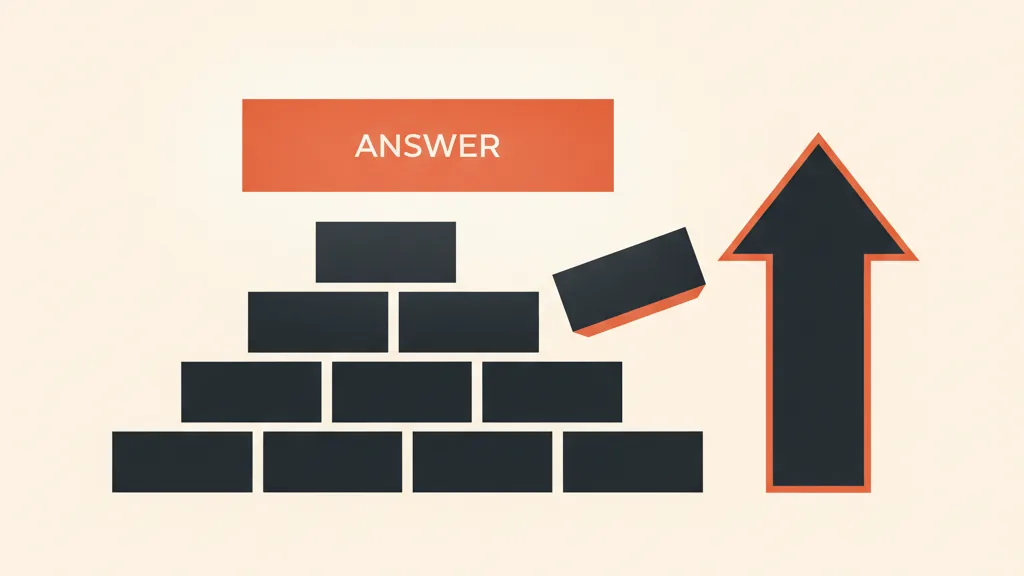
- Answer first, context after. Open every section with the plain answer, then justify and expand on it (the old inverted pyramid of journalism). This is what an AI Overview is most likely to cite.
- Descriptive headings, ideally questions. An H2 like "How much does it cost" or "How does it work" intercepts the real question. Nobody cites "Introductory thoughts."
- Self-contained blocks. Always name the subject in full, avoid "this," "that," "as mentioned above." The machine extracts the paragraph in isolation: if it depends on context, it gets discarded.
- Lists and tables. These are the easiest formats to extract and show in a summary. Wherever you have steps, criteria, or comparisons, use them.
- A summary box. Two lines of "in short" at the top or bottom give the machine (and the reader in a hurry) the compressed version, ready to go.
If you want a proven backbone for organizing persuasive copy within this structure, frameworks like AIDA or PAS still hold up from an SEO angle: they order ideas into a sequence the reader follows effortlessly.
Readability: the rules that never age
Search engine trends change; the way a brain reads a screen doesn't. These practices held in 2016 and still hold in 2026.
- Short paragraphs. Two, three lines. A wall of text gets the page closed.
- Front-load the sentence. Put the key information at the start, not at the end after three subordinate clauses.
- Active voice and concrete verbs. "The system sends the email" beats "the email is sent by the system."
- Bold on the visual anchors. Highlight the concepts where the eye needs to stop, not one random word in every other sentence.
- Words that carry weight. A precise, emotionally resonant vocabulary keeps people reading without padding. A list of high-impact words helps you choose better.
Quick test before you publish: read only the headings and the bold text. If they tell the article's story on their own, the structure holds. If nothing makes sense, rewrite.
Want your content to bring in leads, not just visits? Let's build an editorial strategy ready for the AI Overview era together — talk to us.
How to get cited by LLMs and in AI Overviews
Showing up in generated answers has a recent name: GEO (Generative Engine Optimization) or AEO (Answer Engine Optimization). Acronyms aside, these are concrete practices that raise the odds of being the chosen source.
- Data, numbers, specifics. A model prefers to cite verifiable claims ("roughly 3 searches out of 10 end without a click") over generic statements ("traffic is changing").
- Clarity on entities. Name products, companies, places, and concepts in full and consistently. Machines build the answer by linking entities, not pronouns.
- Original experience. Your own data, real cases, a point of view found nowhere else: this is what an LLM can't synthesize on its own, so it cites you as the source.
- Structured data. Schema markup (Article, FAQ, HowTo) helps engines understand the function of each block. It's not magic, but it makes the content more legible to the machine.
- Freshness and consistency. A visible update date and a consistent message on your site and off it (wherever the brand gets mentioned) reinforce the trust signal.
It's worth remembering this logic applies outside the blog too: the same push toward generated answers is reshaping search advertising, as we cover in the article on how search is changing with AI Mode.
The mistakes that cut you out
- Burying the answer. Three hundred words of preamble before getting to the point: the user has already left, the machine has already picked another source.
- Filler and empty phrases. "In today's ever-evolving landscape" says nothing and gets cited by no one. Every sentence has to add a piece of information.
- Keyword stuffing. Repeating the keyword twenty times was a tactic from ten years ago. Today it hurts both readability and ranking.
- Thin content. Pages that repeat what a thousand others already say, with no data point or angle of their own, have no reason to be chosen.
- Walls of text with no hierarchy. No subheadings, no lists: unreadable for the eye, unextractable for the machine.
A 7-step workflow
- Define the query's intent and check the real SERP.
- Write the promise and the main answer before anything else.
- Build the outline with descriptive H2s (ideally questions).
- Draft in self-contained blocks, one per idea.
- Add data, examples, and at least one original element of your own.
- Run through the revision checklist: cut the excess, check headings and bold text.
- Add structured data, meta title and description, relevant internal links.
If you use an assistant to speed up drafting, keep it on a leash: AI speeds up the first draft, but choosing the data, the real experience, and the final cut stay yours. We go into this in detail in the guide on how to use AI in copywriting without losing the brand's voice.
Writing for the web in 2026 isn't about chasing the latest algorithm update. It's a return to clear, honest, structured writing that serves the person first and, as a result, the machine. All of this is one piece of copywriting for customer acquisition: content that gets read and cited is also the content that brings the right leads, not just visits.
Frequently asked questions
Do AI Overviews kill SEO traffic?
No, but they change it. Zero-click is growing for simple informational searches, while complex and commercial queries still drive clicks. The game shifts to being the source cited in the generated answer, not just ranking position.
What is GEO (Generative Engine Optimization)?
It's the set of practices for getting cited in answers generated by Google and by AI assistants. In practice: answer directly, use verifiable data, self-contained blocks, entities named in full, and structured data.
Does keyword density still matter in 2026?
Very little. Repeating the keyword doesn't help ranking and makes the copy harder to read. What matters more is covering the intent, using synonyms and related entities, and answering the question fully.
How do I know if I'm being cited by LLMs?
Search your main queries on ChatGPT, Perplexity, and Google AI Mode and check whether your site shows up among the cited sources. Some AI visibility monitoring tools are starting to offer dedicated reports, but periodic manual checks remain the most direct method.
Do long-form articles still matter?
Length isn't a goal in itself. What you need is the right depth for the intent: some queries are resolved in 400 words, others need a full guide. 1,200 dense words beat 3,000 padded with filler.
Is schema markup essential for AI Overviews?
It's not mandatory, but it helps. Structured data (Article, FAQ, HowTo) clarifies for search engines what each block does and makes extraction easier. It's an extra signal, not a substitute for clear, well-written content.
We'll turn your blog into a channel that generates leads, not just traffic. Request an analysis of your content strategy.