Predictive Maintenance with Artificial Intelligence: A Manufacturing Guide
9 min read · AstraLoop Studio
An unplanned stoppage on a production line typically costs between 3,000 and 50,000 euros per hour, depending on the industry and how critical the asset is. And the problem is never just the repair. It's the lost production, the orders that slip, the staff standing around with nothing to do and, often, the cascading damage that drags other components down with it. AI-driven predictive maintenance exists precisely for this reason: to stop fixing things after they break (reactive) or on a fixed schedule (preventive), and start intervening at the right moment, before the component fails but not so early that you waste its useful life.
In this guide we look at how this really works in Italian manufacturing. What data you need, what role the digital twin plays, how much a pilot project costs to set up and, above all, how to calculate a credible ROI to bring to management. If you're evaluating AI more broadly for your company, this article is one piece of that journey: for the full picture see our complete guide to AI consulting for businesses, while here we go deep on the manufacturing vertical.
The approach here is practical. No promises of a "zero-failure factory": predictive maintenance done well cuts unplanned downtime by 30-50% and extends asset life, but it demands clean data, a carefully chosen problem, and a minimum of organizational discipline.
Reactive, preventive, predictive: comparing the three strategies
Before talking about AI, it's worth understanding where predictive maintenance sits relative to the classic approaches. Each strategy carries a different cost and a different risk.
| Strategy | When you intervene | Pros | Cons |
|---|---|---|---|
| Reactive (run-to-failure) | After the breakdown | Zero cost as long as things work | Sudden stoppages, collateral damage, unpredictable costs |
| Preventive (scheduled) | At fixed intervals (hours/cycles) | Plannable, simple | Replaces parts that are still fine, doesn't prevent off-cycle failures |
| Predictive (data-driven) | When the data signals degradation | Fewer stoppages, less waste, targeted interventions | Requires sensors, historical data and models |
Preventive maintenance is still the standard in a great many plants today: change the oil every 500 hours, replace the bearing every 6 months. It works, but it's blind. A bearing might fail at 300 hours due to an installation defect, or run happily to 900 hours. In the first case you eat the downtime; in the second you throw away half the component's useful life. Predictive maintenance solves both sides of the problem, because it looks at the asset's actual condition, not the calendar.
How AI-driven predictive maintenance works
The underlying mechanism is easy to explain and hard to execute well. You collect data from machinery continuously, build a model of what "normal operation" looks like, and trigger an alert when behavior deviates in a way that has historically preceded a failure. This is exactly where artificial intelligence comes in, because these patterns are too subtle and multivariate for a fixed threshold to catch.
1. Data: the real raw material
Without data there's no predictive maintenance, full stop. The typical sources in a manufacturing context are these:
- Vibration: the richest signal for motors, bearings, gearboxes, pumps. A bearing that starts to degrade changes its vibration signature weeks before it fails.
- Temperature: abnormal overheating in spindles, coils, electrical panels.
- Current and power draw: rising power draw at the same load signals friction or wear.
- Pressure and flow rate in hydraulic and pneumatic systems.
- Process data from the PLC/MES: cycles, speed, rejects, alarms already logged.
- Maintenance history: what broke, when, and with what symptoms. This is pure gold, and it's almost always buried in Excel sheets or in the maintenance manager's head.
Quality matters more than quantity. A handful of well-instrumented critical assets beats 200 machines with dirty, unsynchronized data. This is also why so many projects fail: teams jump straight to models when the real problem is that the data doesn't exist, isn't labeled, or can't be trusted.
2. Models: from anomaly to forecast
On the technical side, three families of approaches are used, often combined:
- Anomaly detection: the model learns "normal" and flags deviations. Useful when you don't have many failure examples, which is actually the norm — luckily, machines don't break often.
- Fault classification: if you have labeled history, the model learns to recognize the signature of a specific fault (imbalance, misalignment, bearing race defect).
- Remaining useful life (RUL) estimation: predicts how much time is left before failure, so you can plan the intervention within the optimal window.
Deep learning isn't always necessary. In many production settings, a solid statistical model or gradient boosting on well-engineered vibration features outperforms a complex neural network that nobody on the plant floor can explain, both in reliability and in transparency. The practical rule is simple: start with the simplest model that solves the problem, and only add complexity if you truly need it.
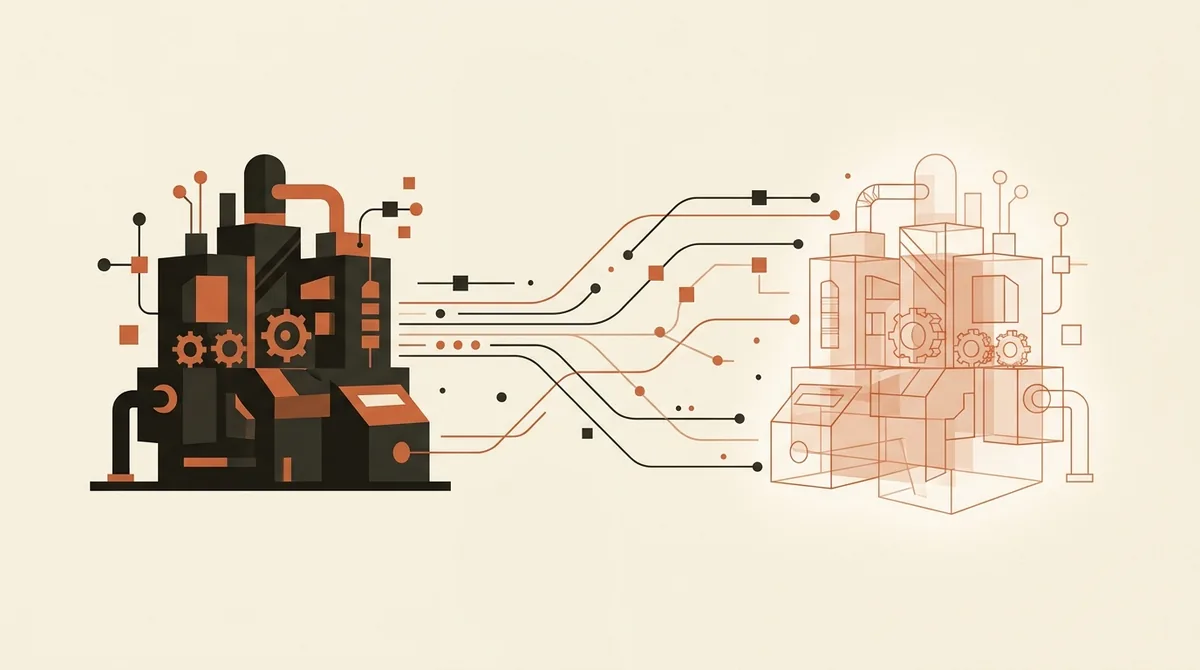
The digital twin: from single component to whole plant
A digital twin is a virtual replica of an asset or an entire plant, fed in real time by sensor data. It's not required to get started, but it becomes powerful once you want to move from monitoring a single bearing to simulating the entire line.
With a digital twin you can do things that would be too costly, or simply impossible, on the physical asset:
- Simulate what happens if you increase production speed by 15%, and see which assets become the bottleneck or go into stress.
- Test failure scenarios ("what happens to the line if this pump fails?") without stopping anything.
- Optimize maintenance schedules by minimizing planned downtime, matching intervention windows to production peaks.
Be careful not to fall in love with the technology, though. A complete digital twin of a plant is a multi-year, costly project. Most manufacturing SMEs capture 80% of the value with a much leaner approach: sensors on a handful of critical assets plus targeted predictive models. The digital twin is a destination, not a starting point. This same principle of starting small applies to AI adoption in general, as we explain in our 4-phase AI adoption roadmap.
How much a predictive maintenance project costs
The numbers vary a lot depending on how many assets you instrument and what you already have in place (network, historical data, existing sensors). Here are realistic ranges for an Italian manufacturing SME starting with a pilot on 3-5 critical assets.
| Item | Indicative range | Notes |
|---|---|---|
| Sensors (vibration, temperature) per asset | €300-1,500 / asset | Wireless costs more but skips the cabling |
| Gateway / edge device + connectivity | €1,000-5,000 | One-time cost per plant |
| Platform setup + data integration | €5,000-20,000 | Depends on how clean the historical data is |
| Model development and tuning (pilot) | €8,000-25,000 | Includes months of baseline data collection |
| Annual maintenance and monitoring | 15-25% of setup cost | Retuning, model drift, alarm management |
The cost almost nobody budgets for is model maintenance. A predictive model isn't software you install and forget. When you switch a batch of raw material, upgrade a machine, or change the production mix, the model needs retuning, because "normal" has shifted underneath it. This phenomenon is called model drift, and it's the main reason brilliant pilot projects stop working after a year. Budget for continuous monitoring from day one. For the broader economics, take a look at our guide on how much it costs to automate business processes.
How to calculate the real ROI
This is where the project is won or lost with management. Predictive maintenance ROI is concrete and measurable, provided you start from an honest number: what unplanned downtime is costing you today.
The basic formula is this:
Annual benefit = (downtime hours avoided × hourly downtime cost) + (savings on spare parts and overtime) + (recovered production value) − system costs
A simplified but realistic example, for a company with one critical line:
- Unplanned downtime today: 40 hours/year on that line.
- Hourly cost of downtime (lost production plus idle labor): €4,000/hour.
- Current annual cost of downtime: €160,000.
- Realistic reduction with well-executed predictive maintenance: 40%, i.e. 16 hours recovered, worth €64,000 in benefit.
- Add savings from randomly replaced parts and night-shift overtime: +€15,000.
- System cost (pilot plus year-1 management): around €35,000.
- Net ROI in year 1: around €44,000. Payback: 5-6 months.
Typical payback periods on these projects run between 4 and 12 months. If you can't estimate your hourly downtime cost, that's the first piece of work to do, even before talking about sensors. For a structured method you can apply to any AI initiative, read how to measure the ROI of artificial intelligence.
Want to know which machines would pay back predictive maintenance the fastest? Request a critical asset assessment and an ROI estimate for your case.
Why projects fail (and how to avoid it)
Around 85% of AI pilot projects never make it to stable production. In industrial predictive maintenance, the recurring reasons are few and predictable:
- Insufficient or dirty data: teams start without a historical baseline and without labeled failures. The model has nothing to learn from.
- Wrong asset choice: instrumenting a machine that almost never breaks. No return, and the pilot "proves nothing."
- Too many false alarms: if the system cries wolf every week, maintenance staff stop trusting it and ignore it. Tuning the sensitivity is crucial.
- Ignoring the human factor: the maintenance manager with 30 years of experience experiences predictive maintenance as a vote of no confidence in his instincts. If you don't bring him in as an ally, the project dies on the shop floor.
This last point is the most underrated in technical articles, and at the same time the number one real reason projects fail. Predictive maintenance doesn't replace the experienced technician: it puts one more tool in his hands and frees him from pointless inspection rounds. It needs to be communicated exactly that way. The issue comes up so often that we've dedicated a deep dive to why AI projects fail and to how to set up AI training for employees so people aren't left behind.
Where to start: a 4-step path
If you want an approach that reduces your odds of landing in that 85% failure rate, move in stages.
- Assessment. Map your critical assets and rank them by downtime cost and failure frequency. Identify 2-3 candidates where one avoided intervention pays for the pilot outright. It's the same logic as an audit of AI use cases for business, applied to production.
- Pilot (quick win). Instrument those few assets, collect baseline data for a few months, build the first model. Goal: demonstrate a measurable result on a real case.
- Scale-up. Extend to similar assets, industrialize data collection, integrate with the MES or maintenance management system.
- Continuous monitoring. Manage model drift, retune periodically, track KPIs (MTBF, downtime hours avoided, alarm precision).
This vertical fits into a broader AI strategy. If you're thinking about what to automate beyond maintenance, take a look at how to integrate AI into business processes coherently, without isolated projects that don't talk to each other.
In summary
AI-driven predictive maintenance is one of the industrial AI applications with the clearest, most verifiable ROI: you cut unplanned downtime by 30-50%, extend asset life, and move from calendar-based maintenance to maintenance based on actual condition. You don't need to start with a billion-euro digital twin. You need to pick 3-5 critical assets wisely, have clean data, a model sized to the problem, and the discipline to manage it over time. And you need to bring people onto the floor with you, not just sensors. Done this way, payback arrives within a few months and the project survives the first change of raw-material batch.
Frequently asked questions
What's the difference between preventive and predictive maintenance?
Preventive maintenance intervenes at fixed intervals (every so many hours or months), regardless of the component's actual condition. Predictive maintenance uses sensor data and AI models to intervene only when the asset shows signs of degradation, avoiding both sudden failures and replacing parts that are still good.
Do you need a digital twin to do predictive maintenance?
No. A digital twin is useful for simulating entire plants and optimizing scenarios, but it's an advanced destination. Most SMEs capture most of the value with sensors on a few critical assets and targeted predictive models, without a full digital twin.
What data do you need to get started?
The most useful are vibration, temperature, current draw, and process data from the PLC/MES, plus the history of past maintenance work. Quality matters more than quantity: a few well-instrumented assets beat many machines with dirty or unsynchronized data.
How much does a pilot project cost in manufacturing?
For a pilot on 3-5 critical assets, indicative costs range from about €15,000 to €50,000 across sensors, data integration, and model development, plus 15-25% per year for model maintenance and retuning. Much depends on how clean the existing historical data is.
How long does it take to recover the investment?
Typical payback is between 4 and 12 months, driven mainly by the unplanned downtime hours avoided. The calculation starts from your hourly downtime cost: if that number is high and stoppages are frequent, the return comes quickly.
By how much can machine downtime be reduced?
With a well-designed project, the reduction in unplanned downtime is typically 30-50%. It's not zero downtime: the goal is to get ahead of avoidable failures and plan interventions in the optimal window, not to promise zero breakdowns.
If you're evaluating a predictive maintenance pilot for your plant, let's talk: we'll define the assets, the data you need, and the expected return together before you invest.