Vulnerability Assessment vs. Penetration Test: What's the Difference
9 min read · AstraLoop Studio
If you've ever asked for a cybersecurity quote, you probably ran into two terms used almost interchangeably: vulnerability assessment (VA) and penetration test (pentest). They're not the same thing. They do different jobs, require different skill sets, and cost very different amounts. A VA starts around €2,000; a serious pentest rarely comes in under €5,000. Mix them up and you either overpay for something you don't need, or pay the right amount for the wrong thing.
Here's the difference in practical terms, no textbook jargon, plus an operating rule that works for most Italian SMBs: a VA every six months plus one penetration test a year. Both are pieces of a complete cybersecurity audit, which is the framework they need to sit inside if you want the money you spend to actually make sense.
This isn't an academic question anymore. According to the 2026 Clusit Report, Italy accounts for roughly 10% of global incidents, with severe attacks up 23% in the first quarter and vulnerability exploitation up 65% versus 2024. SMBs are the target in 72% of cases. We're not talking about big corporations here — we're talking about companies like yours.
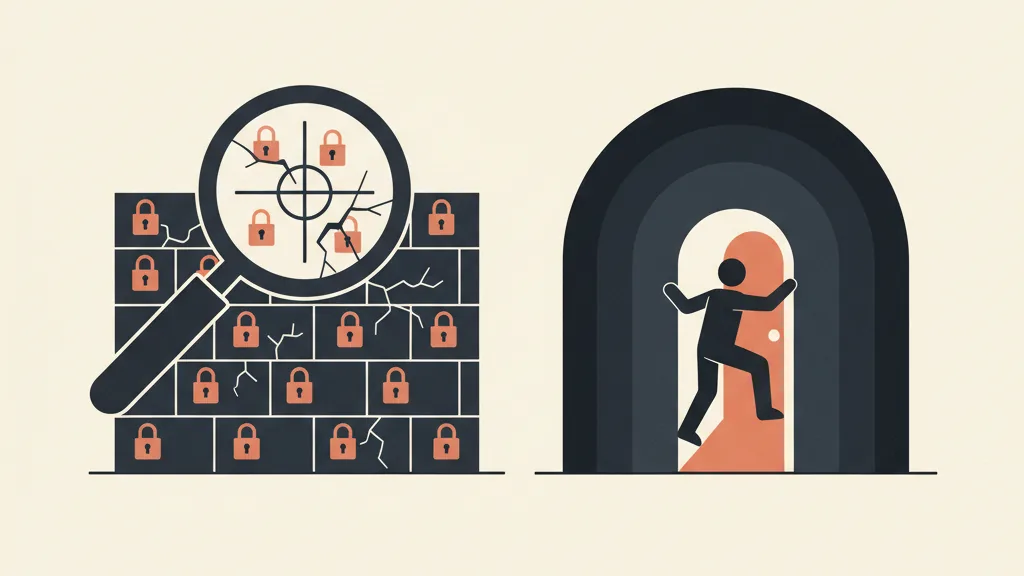
The difference in one sentence
Picture your company's security as a building.
A vulnerability assessment is an inspector walking through the building with a checklist, flagging every door without a lock, every window that doesn't close properly, every rusted padlock. You get a list of problems, ranked by severity. They don't try to get in — they tell you where someone could.
A penetration test is a professional (ethical, working for you) thief you've asked to actually try to break in. They don't just list weaknesses — they chain them together, exploit them, and hunt for the sequence of mistakes that leads all the way to your sensitive data. At the end, they don't just tell you "this door was unlocked" — they tell you "I got in through that door, reached the accounting server, and could have downloaded your entire customer database."
In one sentence: the VA tells you which vulnerabilities exist; the pentest proves how deep an attacker can go by exploiting them.
Comparison table: VA vs. penetration test
| Aspect | Vulnerability Assessment | Penetration Test |
|---|---|---|
| Goal | Identify and list known vulnerabilities | Exploit vulnerabilities to prove real-world impact |
| Approach | Mostly automated (scanner-driven), with human review | Mostly manual, driven by an analyst |
| Breadth vs. depth | Broad: covers many systems, at the surface | Deep: fewer targets, explored thoroughly |
| Question it answers | "Where am I weak?" | "Can an attacker actually get in, and how far can they go?" |
| Output | Report with a list of vulnerabilities and risk levels | Report with successful attack scenarios, paths, and proof |
| False positives | Possible (the scanner also flags things that aren't actually exploitable) | Rare (if it's in the report, it was actually exploited) |
| Typical duration | A few days to a week | One to several weeks |
| Indicative cost (SMB) | €2,000 - €5,000 | €5,000 - €15,000 |
| Recommended cadence | Every six months (or after any major change) | Annually (or after structural changes) |
If you want to go deeper on either one, I've written a dedicated guide on what a vulnerability assessment is and one on what actually drives the cost of a penetration test.
Why one alone isn't enough
To cut costs, the temptation is to pick just one. Here's why that's usually a mistake, in both directions.
VA only: you see the problems but not which ones actually matter
A well-run vulnerability assessment can hand you a list of 150, 200, or more vulnerabilities. That's useful, but without context you risk "list paralysis": you don't know where to start. Many of those findings are low severity or not actually exploitable in your real environment (the classic false positives). The VA tells you ten doors are unlocked, but not which of those doors actually leads to the safe. Great for continuous monitoring, not enough to understand concrete risk.
Pentest only: deep, but with blind spots
A penetration test focuses on specific targets and explores them thoroughly. Precisely because it's targeted and expensive in analyst hours, it can't cover the whole perimeter with the same coverage as a scanner. Running only a pentest once a year leaves eleven months uncovered, during which new vulnerabilities keep appearing. And the numbers back this up: in 2025 alone, more than 11,000 new vulnerabilities were published in the WordPress ecosystem, 97% of them in third-party plugins and themes. A landscape that changes weekly can't be covered by a single annual snapshot.
The two work together. The VA acts as a continuous dragnet, the pentest as a periodic deep check. Together they cover both breadth and severity.
The practical rule for SMBs: VA every six months plus an annual pentest
If I could give you just one operational piece of advice, this is it. For the vast majority of Italian SMBs, the right rhythm is:
- A vulnerability assessment every six months. Typical cost €2,000 - €5,000 per scan. It catches the new vulnerabilities that pile up between one pentest and the next. If you run an e-commerce site or a site with a lot of plugins, consider an even tighter cadence on that part of your perimeter.
- A penetration test once a year. Typical cost €5,000 - €15,000, depending on the complexity and breadth of the perimeter. It verifies that your defenses hold up against a determined attacker.
On top of this fixed cadence come the extraordinary triggers. Re-run the test (at least the VA, and often a targeted pentest too) when:
- you launch a new site, a new management system, or a new internet-facing service;
- you migrate infrastructure, for example to the cloud;
- you onboard a new vendor with access to your systems;
- you've had an incident or an attack attempt that came close to succeeding.
That last point about vendors isn't a side note: 30% of breaches today involve a third party, and supply-chain compromises have quadrupled in five years. The NIS2 directive explicitly requires assessing vendor-related risk, so third-party risk has gone from a good practice to an obligation.
What about budget? An honest ballpark
Add it up, and an SMB following this rule spends roughly €9,000 to €25,000 a year on testing (two VAs plus one pentest). That sounds like a lot until you compare it to the alternative. The average cost of a ransomware incident for an Italian SMB runs €35,000 to €250,000, not counting downtime, reputational damage, and possible fines. Prevention, in perspective, is almost always the cheaper line item. For the full picture, see our dedicated analysis of the real cost of a data breach and the ROI of prevention, and our guide to what drives the cost of a penetration test.
Not sure which of the two to start with for your company? Request an assessment: we'll evaluate your perimeter together and tell you what you actually need, with no automated scans dressed up as pentests.
What the regulations require (NIS2, AI Act, GDPR)
In 2026, the push to run these tests isn't just good sense anymore — it's regulatory. Worth being precise here, because mistakes are costly.
The NIS2 directive (transposed in Italy via Legislative Decree 138/2024) requires entities within its scope to adopt risk-management measures that include periodic security assessments. Through 2026, the operational deadlines kick in: incident-notification obligations starting from the beginning of the year, and baseline security measures expected by October. One thing many business owners underestimate: responsibility falls directly on the management bodies (CEO and board) and can no longer be delegated to the IT department. If you're not sure whether you fall under the obligated entities, start with this check on whether NIS2 applies to your company and then the concrete obligations for SMBs.
The AI Act (EU Regulation 2024/1689) enters a new operational phase on August 2, 2026, with cybersecurity obligations for high-risk systems and oversight assigned in Italy to the ACN. Penalties can reach up to €35 million or 7% of turnover. The GDPR, for its part, requires under Article 32 "appropriate" technical measures and the ability to test and verify them regularly: VA and pentest are among the tools you use to prove you've done that.
One important note: this is information, not legal advice. To understand your exact scope of obligations, it's worth getting a specific assessment of your situation that crosses NIS2, the AI Act, and GDPR together instead of treating them as separate silos.
Automated scan or human audit? Not the same thing
On the market you'll find offers for a few hundred euros promising a "penetration test." In nearly all cases these are automated scans with a new coat of paint. A scanner is useful (it's part of the VA), but a real pentest requires an analyst who reasons through the problem, chains vulnerabilities together, and thinks like an attacker. The difference shows in the report: a scan spits out a list, a human audit tells you the story of a successful attack and explains how to shut it down.
Watch out for a newer risk that scans don't catch: Shadow AI, meaning employees' uncontrolled use of AI tools. 38% of workers admit to having pasted confidential data into tools like ChatGPT or Copilot. No vulnerability scanner will tell you that your sales rep is uploading the customer database to an external service — that takes an audit that looks at processes and people too, not just network ports.
The connection almost nobody explains to you: insurability
There's a very concrete, rarely-discussed reason to run these tests: cyber insurance. More and more insurers, before issuing or renewing a policy, ask for evidence of recent security assessments. A documented vulnerability assessment and penetration test can lower your premium, unlock coverage that would otherwise be denied, and prevent disputes at claim time (the classic clause where the insurer won't pay if it turns out you hadn't adopted "adequate" measures). In practice, the audit isn't just a protection cost — it can partly pay for itself through your insurance premium.
How to choose, in practice
To sum up the decision for your situation:
- Limited budget and starting from zero? Start with a vulnerability assessment. It gives you the full map of weaknesses at the lowest cost and tells you where to act first.
- Handling sensitive data (healthcare, legal, financial) or in scope for NIS2? You need the full pair: VA for breadth, pentest to prove your defenses hold. And likely a combined audit that also touches GDPR and the AI Act.
- Running an e-commerce site or a WordPress site with lots of plugins? Prioritize the web surface: frequent VAs on that perimeter (sites get attacked roughly every few minutes on average) and at least one annual pentest on the application.
- Already had an incident or attempt? Don't wait for the regular cadence: run a targeted pentest right away to find out if and how they got in, and whether they're still inside.
The worst thing you can do is nothing, convinced you're too small to matter to anyone. The Clusit numbers say the opposite: SMBs aren't spared — they're targeted precisely because they're less defended. A six-monthly VA and an annual pentest are the bare minimum for sleeping soundly, and for proving to a judge or an insurer that you did your part.
Frequently asked questions
What's the main difference between a vulnerability assessment and a penetration test?
A vulnerability assessment identifies and lists the vulnerabilities present in your systems (it tells you where you're weak), while a penetration test actively tries to exploit them to prove how far an attacker can get. The first is broad and automated, the second is deep and manual.
How much does a vulnerability assessment cost compared to a penetration test?
For an Italian SMB, a vulnerability assessment costs roughly €2,000-€5,000, while a penetration test starts at €5,000 and can reach €15,000 depending on the breadth and complexity of the perimeter. The difference reflects the greater manual effort a pentest requires.
How often should you run a VA and a penetration test?
The practical rule for SMBs is a vulnerability assessment every six months and a penetration test once a year, plus extraordinary tests after any major change: a new site or management system, a cloud migration, a new vendor with system access, or after an incident.
Is just one of the two enough for my company?
Usually not. A VA alone gives you a list without telling you which vulnerabilities actually matter; a pentest alone leaves the eleven months between tests uncovered, during which new flaws appear. The pair covers both breadth and severity.
Is a penetration test legally required?
No regulation literally names the pentest, but NIS2 (Legislative Decree 138/2024), GDPR (Article 32), and the AI Act (EU Reg. 2024/1689) require periodic assessments and adequate, testable measures. VA and pentest are the tools you use to prove it. This is information, not legal advice.
Does a cheap automated scan count as a penetration test?
No. Offers for a few hundred euros are almost always automated scans, part of a VA but not a real pentest. A genuine penetration test requires an analyst who chains vulnerabilities together and thinks like an attacker, with a report showing successful attack scenarios.
Want to set the right cadence for VA and penetration testing and align with NIS2, GDPR, and the AI Act? Talk to us and let's build a plan tailored to your SMB.